
Every flower starts as a quiet, closed secret. Long before petals open, there is a hidden stage most people never notice. This guide is about that stage. It covers the buds, pods, and pre-bloom shapes that hold every future flower inside.
A magnolia bud survives a frosty winter. A rosebud waits in a florist’s cooler. Each plant hides its beauty in its own way. Knowing different unbloomed flower names changes how you see your own garden. This guide walks you through all of them, one clear section at a time.
What Are Unbloomed Flowers Called?
The simple word for an unopened flower is a bud. In botany, a bud is a small growth on a stem. It holds an undeveloped flower, leaf, or shoot inside a protective layer. When that growth will become a flower, it is called a flower bud.
Gardeners use many other words too. Some depend on the plant. Some depend on the exact stage. Learning these unbloomed flower names gives you a richer way to describe what a plant is really doing before it blooms.
- Bud (the general term for an unopened flower)
- Flower Bud (a bud that will become a flower)
- Unopened Blossom (a flower that has not spread open)
- Pre-Bloom Flower (a flower still in early growth)
- Closed Bloom (a flower kept shut by its own petals)
- Pip (a small bud found on tubers)
- Eye (a bud on a potato or similar tuber)
- Immature Flower (a flower not yet fully formed)
- Floral Node (the exact point where a bud begins)
- Bud Cluster (several small buds grouped together)
- Nascent Bloom (a flower just starting to form)
- Sealed Flower (a bud tightly wrapped by scales)
- Embryonic Flower (a flower at its very first stage)
- Resting Bloom (a bud paused before it opens)
Botanical Stages of a Flower Bud (From Formation to Bloom)
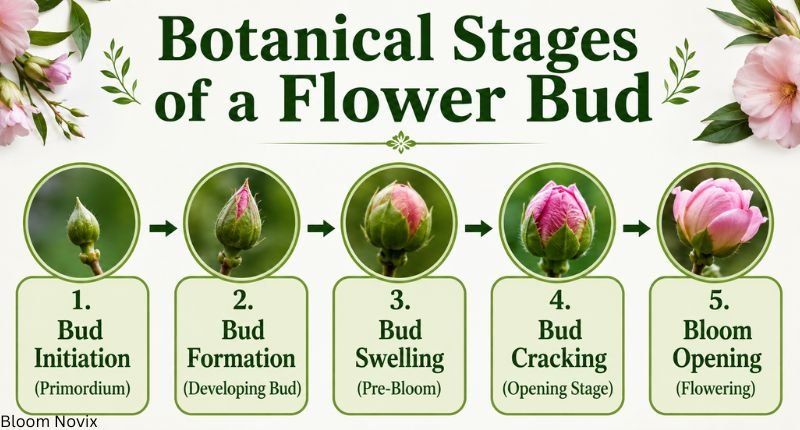
A flower bud does not appear overnight. It moves through clear stages, and each stage has its own name in horticulture. The process starts with initiation, when a few cells decide to become a flower instead of a leaf.
Weather changes this timeline often. A warm spring speeds up bud swelling. A sudden cold snap can pause the whole process for days. Neither change usually harms a healthy bud.
| Stage | What Happens |
| Initiation | Cells begin forming a flower instead of a leaf |
| Swelling | The bud grows larger and scales stretch |
| Bud Break | The protective covering starts to split |
| Color Show | Petal color becomes visible for the first time |
| Anthesis | The flower is fully open and ready for pollination |
Growers often plan pruning and feeding around these stages, not the calendar. A plant’s own timing is more reliable than any fixed date.
General Bud and Flower Bud Names
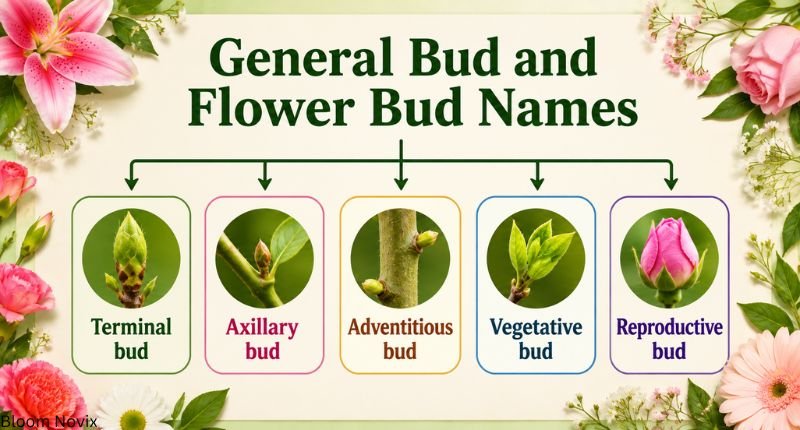
Botany has a rich vocabulary for bud position and bud function. Some terms describe where a bud sits. Others describe what it becomes. A few describe how long it waits before growing.
This vocabulary is genuinely useful. Nursery tags and plant labels use these words constantly, and knowing them removes a lot of confusion. Many of the unbloomed flower names below feel technical at first. Once you match each one to a real bud, they stick in memory fast.
- Terminal Bud (grows at the very tip of a stem)
- Axillary Bud (forms where a leaf meets the stem)
- Adventitious Bud (grows in an unexpected spot, like a root)
- Leaf Bud (develops into leaves)
- Reproductive Bud (grows into a flower)
- Mixed Bud (produces both leaves and flowers)
- Latent Bud (stays dormant for years before growing)
- Accessory Bud (sits beside a main bud as a backup)
- Floral Primordium (the first cells that form a flower)
- Inflorescence Bud (holds a full cluster of flowers)
- Naked Bud (has no protective scales at all)
- Scaly Bud (covered by tough overlapping scales)
- Solitary Bud (grows alone, not in a cluster)
- Compound Bud (holds several smaller buds inside one shell)
Difference Between a Bud, Pod, Calyx and Sepal
These four words get confused often, even by regular gardeners. A bud is the whole unopened flower. A pod usually forms after pollination and holds developing seeds instead. The calyx is the ring around a bud, and a sepal is one single piece of that ring.
| Term | What It Actually Is |
| Bud | The complete unopened flower, petals included |
| Pod | A seed-holding structure that often forms after bloom |
| Calyx | The full ring of protective parts around a bud |
| Sepal | One single segment of the calyx |
Knowing the difference matters more than it seems. “Remove the pod” and “pinch the bud” are two very different instructions, and mixing them up can stop a flower before it even starts.
Fruit Tree Flower Buds
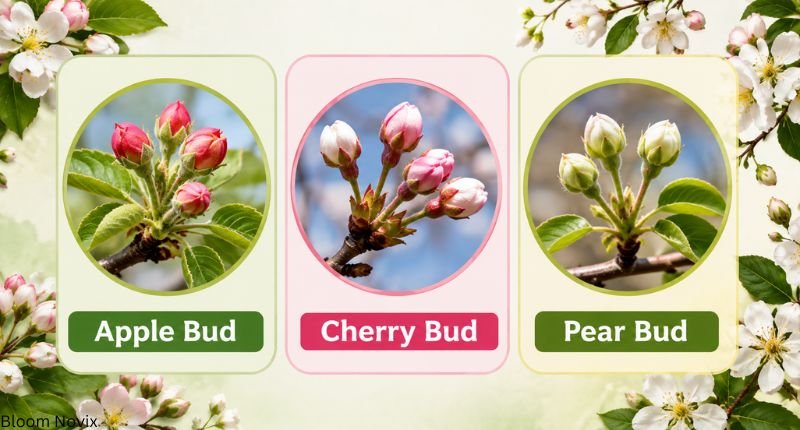
Fruit trees produce some of the most rewarding buds to watch. A bud today often means fruit later in the season, so orchard growers track these stages closely.
Many fruit buds carry soft fuzz for a reason. That fuzz traps warm air and protects delicate petals from a sudden spring frost.
- Peach Bud (soft and slightly fuzzy)
- Apple Bud (pink before it opens white)
- Cherry Bud (small and tightly clustered)
- Pear Bud (pale green with a waxy layer)
- Apricot Bud (blush pink and delicate)
- Plum Bud (rounded with light fuzz)
- Fig Bud (green and slightly pear shaped)
- Almond Bud (one of the earliest bloomers in late winter)
- Pomegranate Bud (bright orange red)
- Lemon Bud (fragrant even before it opens)
- Orange Bud (waxy white before bloom)
- Lime Bud (small and pale green)
- Quince Bud (fuzzy and clustered in pink)
- Persimmon Bud (small and pale yellow)
- Olive Bud (tiny and clustered along the stem)
Read Also: National Flower Day
Ornamental Flower Buds
Ornamental plants exist purely for beauty, and their buds often match the drama of the open flower. A peony bud looks like a small green marble. A magnolia bud looks like a soft, furry mitten.
Choose ornamentals with a slow bud stage if you enjoy watching the process. Peonies, camellias, and hydrangeas all hold an interesting bud shape for several days before opening fully.
- Rosebud (tightly wrapped and classic)
- Tulip Bud (pointed and richly colored)
- Peony Bud (round like a small marble)
- Magnolia Bud (covered in soft fur)
- Camellia Bud (glossy with a reddish tint)
- Hydrangea Bud (clustered into a tight dome)
- Daffodil Bud (wrapped in a papery green sheath)
- Iris Bud (slim, upright, and pointed)
- Lilac Bud (small and packed into clusters)
- Hyacinth Bud (marble sized and fragrant)
- Gardenia Bud (creamy white and waxy)
- Rhododendron Bud (large, firm, and pointed)
- Dahlia Bud (round with layered outer scales)
- Zinnia Bud (boxy before its petals spread)
- Carnation Bud (slim with ruffled edges)
Wildflower Buds
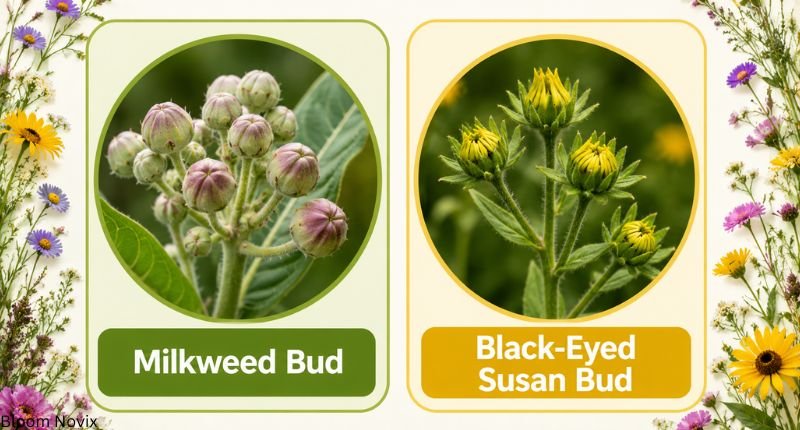
Wildflowers rarely get the attention garden favorites do, yet their buds are often more detailed. Many wild species protect their buds with fine hairs or leaf-like bracts, since no one is there to shield them from weather.
A coneflower bud looks like a tiny green cone long before its purple petals appear. Watching wild buds open is a simple way to connect with a local meadow.
- Coneflower Bud (a green cone before petals show)
- Milkweed Bud (clustered into tight little balls)
- Black-Eyed Susan Bud (small and gently domed)
- Aster Bud (thin, pointed, and star shaped)
- Goldenrod Bud (tiny and packed into spikes)
- Clover Bud (round, low, and compact)
- Thistle Bud (spiky with a purple tipped crown)
- Queen Anne’s Lace Bud (flat, green, and lacy)
- Bee Balm Bud (shaggy and upright)
- Fireweed Bud (a tall spike of small buds)
- Buttercup Bud (glossy, rounded, and small)
- Chicory Bud (slender on thin wiry stems)
- Yarrow Bud (flat clusters of tiny buds)
- Lupine Bud (shaped like a tall spire)
Edible and Culinary Buds
Some of the most common foods on your plate started as flower buds. Broccoli and cauliflower are literally dense clusters of tiny buds, picked long before they open.
Texture matters as much as taste here. Because the petals are still tightly packed, edible buds hold a firmer bite than an open flower, which is why so many hold up well in quick cooking.
- Broccoli Bud (a dense green cluster)
- Cauliflower Bud (packed tightly into one head)
- Artichoke Bud (large and thistle shaped)
- Caper Bud (small and pickled while young)
- Daylily Bud (crisp with a mild sweetness)
- Chive Bud (a round purple globe)
- Nasturtium Bud (peppery and small)
- Saffron Crocus Bud (holds the prized red threads)
- Squash Blossom Bud (often stuffed and fried whole)
- Linden Bud (mild with a slightly nutty taste)
- Garlic Scape Bud (the plant’s unopened flower stalk)
- Onion Bud (harvested before it ever flowers)
- Broccoli Rabe Bud (smaller and more bitter)
- Violet Bud (delicate with a mild sweetness)
Explore More: Lotus Flower Season
How to Harvest and Store Edible Flower Buds Safely
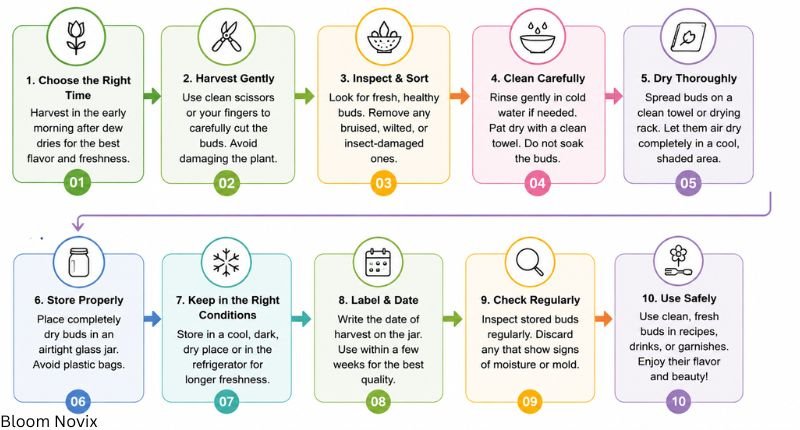
Timing and cleanliness matter most when harvesting buds to eat. Pick in the cool morning hours, when buds are firm and unstressed by afternoon heat.
Never harvest from plants treated with pesticides. Rinse buds gently, then dry them fully before storing, since trapped moisture speeds up spoilage.
- Harvest early in the day, before the heat sets in
- Skip any plant treated with pesticides or grown near traffic
- Rinse buds gently and dry them completely
- Store in a breathable, paper-lined container
- Pickle or salt any buds meant for long-term storage
Winter and Dormant Buds
Winter is far from empty in the garden. Many trees hold fully formed flower buds through the cold months, protected by tough scales or a natural waxy coating.
A healthy winter bud feels plump and firm. A damaged one looks shriveled or loose, and it likely will not open when spring arrives.
- Witch Hazel Bud (blooms even through frost)
- Forsythia Bud (bright yellow once open)
- Redbud Cluster (holds tight through deep winter)
- Pussy Willow Bud (soft, grey, and catkin shaped)
- Winter Jasmine Bud (small and star shaped)
- Daphne Bud (fragrant even in freezing air)
- Cornus Bud (small, pointed, and firm)
- Viburnum Bud (clustered in dusty pink)
- Paperbush Bud (golden with a papery shell)
- Wintersweet Bud (small, waxy, and fragrant)
- Hellebore Bud (nodding with a leathery texture)
- Snowdrop Bud (tightly closed and pure white)
- Winter Hazel Bud (strung like beads along the stem)
- Camellia Winter Bud (scaly, round, and firm)
Partially Opened Flowers
Between a closed bud and a full bloom sits a stage most people skip past: the partially opened flower. The outer covering has cracked, and color starts to show through.
Florists often prefer this exact stage. A half-open flower keeps opening slowly in the vase, giving a bouquet a much longer life.
- Half-Open Rose (petals loosely unfurled)
- Cracking Tulip Bud (scales just starting to split)
- Blushing Peony (color barely showing through)
- Loosening Lily Bud (curling gently at the tip)
- Emerging Gladiolus (petals starting to separate)
- Opening Foxglove (papery covering splitting open)
- Unfurling Azalea (petals just beginning to spread)
- Showing-Color Larkspur (color visible through the sheath)
- Split-Calyx Statice (the outer casing cracked open)
- Parting Begonia (folds just beginning to release)
- Waking Crocus (petals lifting slightly upward)
- Teasing Freesia (the trumpet barely visible)
Unique Bud Shapes and Descriptions
Not every bud looks like a simple round ball. Some buds earn nicknames purely because their shape resembles something else entirely.
Persian ironwood produces small brown buds that look like chocolate chips. Winter-hazel buds sit along the stem like beads on a thread.
- Chocolate-Chip Bud (Persian ironwood’s dark round shape)
- Bead-Like Bud (strung along a stem, one after another)
- Urn-Shaped Bud (thick, leathery sepals around the center)
- Paintbrush Bud (long, slender, with a soft tip)
- Medusa Bud (tangled purple stems in a cluster)
- Fuzzy Mitten Bud (a soft fur covering, like a small glove)
- Berry-Like Bud (round and red, easily mistaken for fruit)
- Collar Bud (boxy green bracts around the base)
- Lancelike Bud (narrow with a sharp, pointed tip)
- Sparkling Bud (fine hairs that catch and scatter light)
- Waxy Bead Bud (a smooth, glassy outer coating)
- Sticky Bud (coated in a thin layer of natural resin)
- Feathery Bud (wispy edges instead of firm scales)
- Spiral Bud (a twisted shape before it straightens out)
Floral Design and Cut Flower Buds
Florists rely on buds more than fully open flowers, mainly because a bud lasts longer once cut. A rose cut at bud stage can last over a week in water.
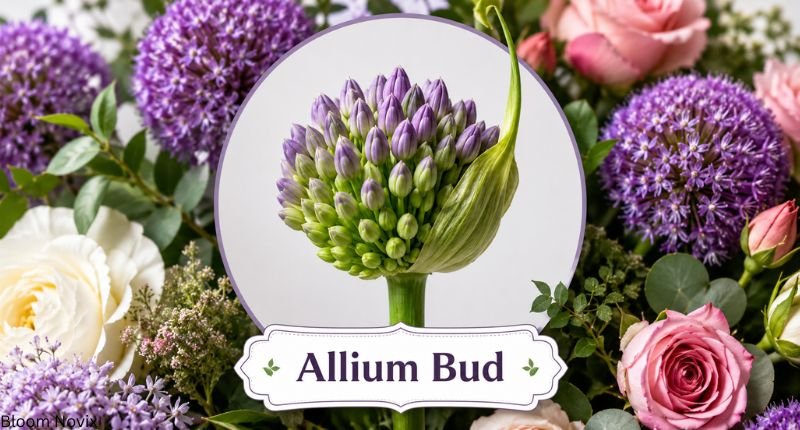
Certain plants are grown almost entirely for their bud stage. Allium holds its round shape for weeks before the purple flowers ever appear.
- Allium Bud (a round green orb on a tall stem)
- Sea Holly Bud (a metallic blue cone shape)
- Nigella Pod (papery and lantern shaped)
- Scabiosa Pod (delicate and shaped like a pincushion)
- Echinacea Cone (spiky before petals appear)
- Delphinium Spike (buds packed tightly along a stalk)
- Snapdragon Raceme (buds stacked from bottom to top)
- Ranunculus Bud (layered like folded tissue paper)
- Protea Bud (thick, leathery, and slow to open)
- Astrantia Bud (small and studded like a tiny star)
- Eryngium Bud (a spiky silver-blue head)
- Craspedia Bud (a small, round, golden ball)
- Amaranthus Bud (long and trailing like a tassel)
- Clematis Bud (light, feathery, with wispy edges)
See More: April Birth Flowers
How to Make Cut Flower Buds Last Longer in a Vase
A few small habits stretch how long a cut bud stays fresh. Cut stems at a sharp angle under running water, since this stops air bubbles from blocking water flow.
Change the vase water every two days, and keep arrangements away from direct sun and ripening fruit. Fruit releases a gas that speeds up aging.
- Cut stems at an angle, always under running water
- Change the vase water every two days
- Trim a small amount off the stem at each change
- Keep the vase away from heat, sun, and fruit bowls
- Add a small pinch of sugar to the water
How To Identify Unbloomed Flowers
Identifying a plant from its bud alone takes some practice, but it gets easy fast. Shape is usually the first clue, since a round bud and a pointed bud belong to very different plant families.
Look at the whole plant too, not just the bud. Leaf shape and stem thickness can confirm an identification when the bud alone leaves you unsure.
| Clue | What to Check |
| Shape | Round, pointed, flat, or elongated |
| Texture | Fuzzy, smooth, waxy, or sticky |
| Color | Green, red, brown, or silver tones |
| Size | From a tiny pinhead to a large bulb shape |
| Position | Terminal at the tip or axillary at a leaf joint |
Keeping a photo log by date and plant name is one of the fastest ways to build this skill in a single season.
Common Reasons Buds Fail to Bloom (And How to Fix Them)
It is frustrating when a plant forms buds and drops them without ever flowering. Inconsistent watering is one of the most common causes, since stress makes a plant abort buds to save energy.
Poor light, sudden cold, and small pests like aphids are the other usual suspects. Too much nitrogen fertilizer can also push growth into leaves instead of flowers.
- Keep watering steady, not just frequent
- Match the light level to what the species actually needs
- Shield plants from sudden cold snaps
- Check often for aphids, thrips, and mites
- Switch to a lower-nitrogen, bloom-boosting fertilizer
How to Force Flower Buds to Bloom Indoors
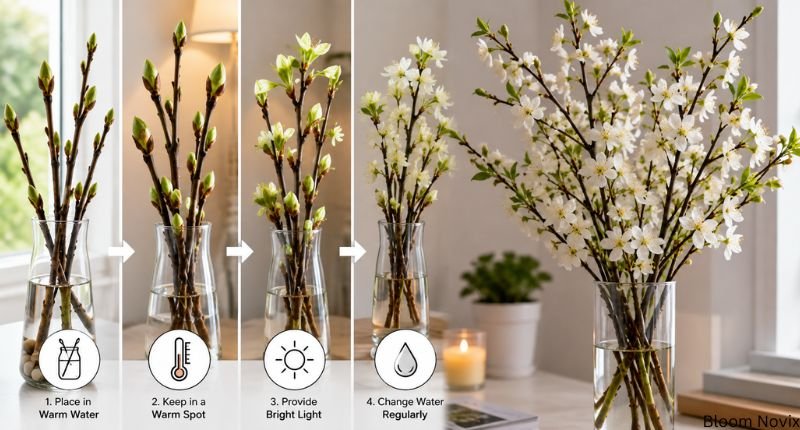
Bringing dormant branches indoors is an old trick that still works well today. Forsythia, quince, and flowering cherry all respond nicely, especially after a few weeks of real winter cold outdoors.
Cut branches cleanly, then place them in room-temperature water away from direct sun. Buds usually swell and open within one to three weeks.
- Pick branches that already had some winter cold
- Cut the stems cleanly at an angle
- Set them in room-temperature water, out of direct sun
- Refresh the water every few days
- Expect blooms within one to three weeks
Symbolic Meanings of Unbloomed Flowers
Across cultures, an unopened flower almost always means the same few things: potential, patience, and quiet hope. A bud is unfinished, and that unfinished quality is exactly why people connect with it so deeply.
This is part of why so many people search for unbloomed flower names in the first place. A single word like “bud” feels too plain for something carrying this much meaning.
- Potential and growth still waiting to happen
- Youth and the start of something new
- Patience during a slow, quiet wait
- Hope returning after a hard season
- Early affection that is only beginning
- Purity, in several cultural traditions
- Renewal, especially tied to spring
Unbloomed Flowers in Art, Poetry and Culture
Poets and painters have used the unopened flower as a symbol for centuries. A closed bud lets a writer describe a feeling without naming it outright.
Classical poetry from Japan and Persia both return to the bud again and again. Painters often place a single closed bud beside a full bloom in the same still life.
- A frequent symbol in classical poetry
- A common subject in still-life painting
- Used in literature to suggest restrained emotion
- Featured in traditional textile and pottery patterns
- A recurring motif in wedding ceremonies
- Present in lullabies and children’s stories about growth
How To Use Unbloomed Flowers in Gardening
A garden filled only with open flowers can feel oddly flat. Buds add a sense of anticipation, and mixing bud-heavy plants with open blooms keeps a garden interesting for longer.
Buds are practical too. Many attract pollinators before the flower even opens, and dormant winter buds give real structure when nothing else is blooming.
- Mix budding plants with blooming ones for longer interest
- Use bud-heavy stems in dried arrangements
- Choose plants with attractive winter buds for cold-season structure
- Let a few buds mature fully to encourage repeat flowering
- Watch bud swelling as a natural planting signal
Best Flowers to Grow If You Want to Watch Them Bloom
Some flowers move through the bud stage slowly enough to watch day by day. This makes them ideal for beginners or for gardening with kids.
Sunflowers take almost two weeks from visible bud to full bloom, giving plenty of time to observe every small change.
- Sunflower (bud opens slowly over two weeks)
- Morning Glory (a fresh bud opens every single morning)
- Four O’Clock (buds open on schedule each evening)
- Moonflower (a bud unfurls only after dark)
- Evening Primrose (opens fast enough to watch in minutes)
- Hibiscus (each bloom lasts only one full day)
- Petunia (buds open in a slow, gentle spiral)
- Cosmos (a slow, steady bud swelling)
- Marigold (buds open gradually across a week)
- Portulaca (fresh petals open every sunny morning)
- Poppy (a papery bud splits open within hours)
- Cape Daisy (petals unfold in under an hour)
Photographing Flower Buds: Tips for Capturing Pre-Bloom Beauty
Buds are rewarding subjects for photos, but they need a different approach than open flowers. Soft morning light works best, since it highlights fine hairs without washing out color.
Get close, but keep enough distance for sharp focus. A macro setting or phone portrait mode reveals texture that is invisible to the naked eye.
- Shoot in soft morning or evening light
- Use a macro setting to capture fine texture
- Try a lower angle against open sky
- Include a small piece of stem for scale
- Photograph the same bud daily to show its progress
Read This Article: Ugly Flower Names
Final Words
Every bud you see, on a rose bush or a wild meadow plant, quietly holds the entire future of that flower inside it. Learning these unbloomed flower names is not just about vocabulary. It changes how closely you look at the plants already growing around you.
The next time you pass a closed bud, take a moment to really see it. Notice the shape, the texture, and the faint hint of color trying to show through. That small, patient structure proves that beautiful things take real time to arrive.
FAQs
What do people call an unbloomed flower?
Most people call it a bud or a flower bud. There are, however, many more specific unbloomed flower names used by botanists and gardeners for different stages and positions.
Why do flowers stay in the bud stage?
Flowers stay in bud form while their inner parts finish developing. Light, temperature, and overall plant health all affect how long this stage lasts.
Do all flowers start as buds?
Yes. Nearly every flowering plant passes through a bud stage first. The bud protects delicate tissue from cold, pests, and physical damage while it forms.
Can gardeners identify flowers from their buds?
Experienced gardeners often can. Shape, size, color, and texture usually stay consistent within one species, so recognition gets easier with practice.
Which plants produce the most beautiful flower buds?
Magnolias, peonies, roses, camellias, and cherry trees are often named for having buds that rival the beauty of the fully open flower.
Why do some flower buds never bloom?
Inconsistent watering, poor lighting, pest damage, and sudden temperature swings are the most common reasons a bud stalls and drops.
Do flower buds change color before blooming?
Yes. Many buds shift color gradually, often starting green before showing hints of pink, red, yellow, or purple just before opening.
Can people use flower buds for decoration?
Yes. Florists often choose buds over open flowers, since buds last longer in a vase and keep opening slowly after being cut.
Which edible foods come from flower buds?
Broccoli, cauliflower, capers, and artichokes are common foods that are, in fact, harvested flower buds rather than any other plant part.
Why do some buds feel soft or fuzzy?
Fine hairs on a bud trap a thin layer of warm air. This protects delicate inner tissue from cold, moisture loss, and small insects.
How long does a flower bud take to bloom?
Timing depends on the species. Some buds open within days, while others, especially on trees, may take several weeks.
What symbolizes an unopened flower bud?
An unopened bud usually symbolizes potential, patience, and hope. It suggests something good is still developing, even before it fully shows.
What are some unheard-of flower names?
The parrot’s beak, jade vine, and ghost orchid rarely come up in daily conversation, despite having strikingly unusual bud and bloom stages.
What are some unique flower names?
Names like naked man orchid, dancing girls orchid, and monkey face orchid stand out because they describe shape, not color or family.
What is the rarest flower name?
The youtan poluo, a legendary bloom said to appear only once every few thousand years in folklore, is often called one of the rarest flower names in botanical storytelling.
BloomNovix is managed by an experienced team of content writers and SEO specialists with 4+ years of expertise in gardening and plant care. We provide well-researched guides, gardening tips, and insights on floral meanings to help plant lovers grow their indoor and outdoor gardens with confidence.

2 thoughts on “Unbloomed Flower Names: 100+ Buds, Pods & Pre-Bloom Beauties You Need to Know”