
There is something almost otherworldly about watching a lotus rise out of still, muddy water and open into a flawless bloom. It happens every single year, yet it never quite loses its magic. If you’ve ever stood beside a pond during lotus flower season and wondered why some ponds bloom for months while others go quiet in weeks, you’re not alone.
This guide walks through the full lotus blooming season, region by region, along with 15 genuinely interesting facts about how this flower behaves and why it’s biologically unlike almost anything else on Earth. You’ll also find tested advice on growing your own lotus and keeping cut blooms fresh, whether you’re simply curious or planning to grow one yourself.
When Is Lotus Flower Season?
The honest answer is: it depends entirely on where you live. The lotus flower season bloom time isn’t fixed on a single calendar, because Nelumbo nucifera — the sacred lotus — is deeply sensitive to water temperature, sunlight, and rainfall. In tropical countries the lotus flowering season can stretch across most of the year, while temperate regions compress it into one short summer window.
What actually flips the switch is water temperature. Lotus rhizomes stay dormant until pond water consistently holds above roughly 20–21°C (68–70°F), and once that threshold is crossed, new shoots push upward almost immediately. That’s why the same species can already be blooming in Singapore in January while a pond in Germany waits until June.
Here’s a quick regional snapshot before we go month by month in detail:
| Region | Peak Blooming Months | Off-Season Behavior |
| Singapore, Thailand, Indonesia | Nearly year-round, strongest May–Jan | Slower blooms, rarely fully dormant |
| India | June – September | Late blooms into early autumn |
| China | June – August | Dormant through winter |
| Vietnam | July peak (West Lake season) | Reduced blooms Nov–Feb |
| Japan | July | Dormant through winter |
| North America & Europe | June – August | Full dormancy Nov–March |
January – March
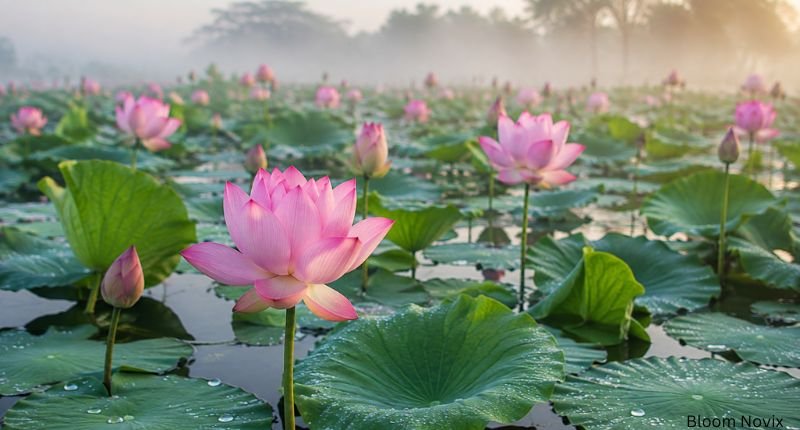
In tropical zones, the lotus growing season never fully switches off, but January to March is a rewarding stretch in Singapore, Thailand, and Indonesia. This lines up with the tail end of the monsoon lotus flowers season, when leftover rainfall and humidity keep water warm and pond levels topped up.
Unlike temperate lotus, which dies back completely for winter, tropical lotus rarely dips below its dormancy threshold, so it keeps producing a slow, steady trickle of blooms even in the off-season. Temple ponds tend to be the most reliable place to see them during these months, since grounds are usually maintained year-round.
April – June
This is where the lotus flowering months genuinely build momentum across the Northern Hemisphere. In India — especially Kerala and northern regions — pre-monsoon warmth and rising humidity trigger a strong early bloom, and China sees its first buds by late April or May. By June, gardens in North America and Europe usually see their first shoots too.
Early blooms tend to be smaller and less frequent, since a newly active rhizome directs energy into leaf growth before flowering ramps up. This is a normal part of the lotus flower lifecycle, not a problem — and once fully established, a single healthy rhizome can go on to produce well over a hundred blooms across the season.
Read More: Ugly Flower Names
July – August
If you only see lotus flower season once a year, this is the window to prioritize. July and August mark the peak of the lotus bloom period almost everywhere the plant grows, from India’s monsoon-fed ponds to China’s Weishan and Jinan lotus festivals. Southeast Asia stays in full bloom through its rainy season lotus window, and summer in Europe and North America brings summer blooming aquatic flowers to their best display of the year.
This is also when the flower’s strangest biology shows itself. Lotus blooms are thermogenic, generating their own internal heat to stay warmer than the surrounding air, likely to attract pollinators on cool mornings. Yet each individual flower still only lasts three to five days, shifting from deep rose on day one to pale pink by the time its petals fall — a detail most visitors miss unless they revisit the same pond.
September – October
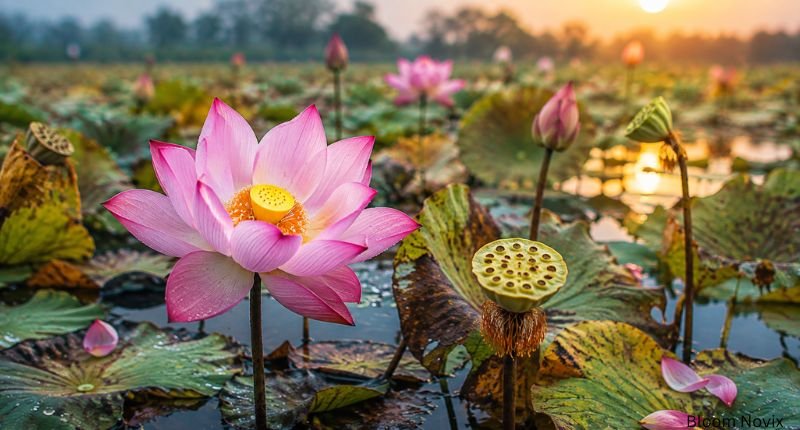
As autumn arrives, the lotus flowering season winds down in cooler climates, with fewer new buds appearing across North America and Europe. Southeast Asia’s extended monsoon keeps ponds blooming a little longer, and parts of India hold on to late flowers as the rains taper off through September.
Deeper, south-facing ponds tend to stay warm and keep blooming longest into autumn, while shallow ponds cool and finish earlier. Once petals fall, a flat, perforated seed pod is left behind — often called a “shower head” pod — which matures further and is widely used in dried floral arrangements.
November – December
By November and December, lotus in temperate climates has entered full lotus winter dormancy. The visible plant dies back while the rhizome survives underground, waiting for warmer water in spring. Tropical regions like Singapore and Thailand barely experience a lotus dormant season at all, thanks to steady warmth.
Winter care is minimal — simply clearing dead foliage and keeping the rhizome below the frost line is usually enough. Remarkably, some lotus seeds recovered from dried lakebeds have germinated after over a thousand years of dormancy, protected the entire time by an unusually hard, waterproof outer shell.
Explore More: December’s Birth Flower
Why Blooming Season Length Varies by Region
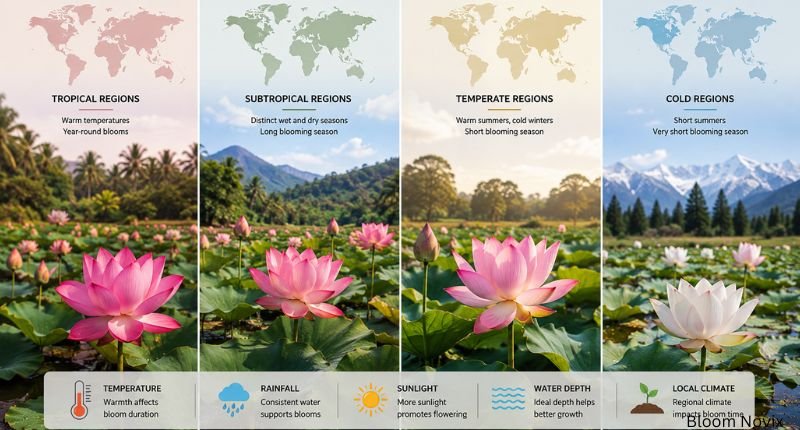
The lotus bloom period can last three months in one country and nearly twelve in another, and three factors explain most of it: temperature consistency, day length, and rainfall. Tropical zones near the equator barely experience seasonal swings, so the dormancy trigger rarely fully activates.
Temperate zones face a sharp seasonal cycle instead, compressing the plant’s entire above-ground life into five or six months before it retreats underground. Tropical lotus tends to bloom in a steady trickle across many months, while temperate lotus produces a shorter, more dramatic flush — two different survival strategies shaped entirely by climate.
Tips For Growing Lotus Flowers
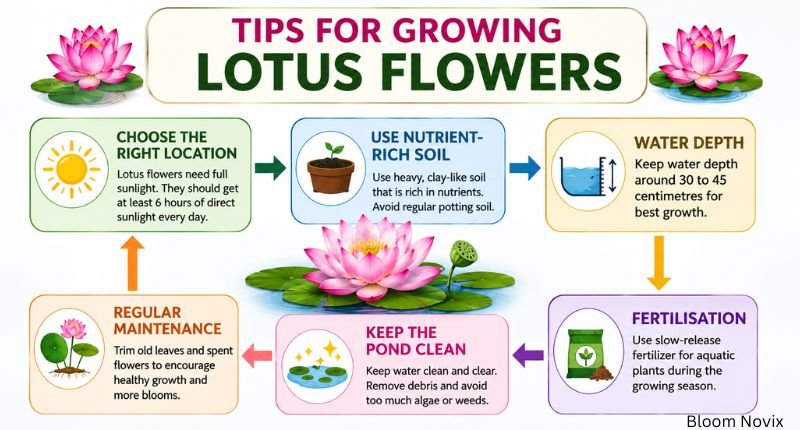
Lotus flower season plants are forgiving once a handful of core conditions are met, which makes them a realistic project for most pond or container gardeners. Sunlight, soil, and water depth matter far more than any specialized product or trick.
Getting these basics right early on also prevents the most common early frustration — plenty of leaves but no flowers — which almost always comes down to one of the factors below rather than anything more complicated.
- Sunlight: at least six hours of direct sun daily; shade keeps the plant alive but rarely produces strong blooms
- Soil: heavy, clay-based soil to anchor the rhizome — standard potting soil floats away
- Water depth: roughly 30–45 cm; too shallow risks overheating, too deep slows leaf growth
- Fertilizer: a slow-release aquatic feed every 3–4 weeks during the growing season
- Pond care: clear away algae and debris weekly to protect light and nutrient levels
- Propagation: divide healthy lotus rhizomes rather than growing from seed, keeping one growing tip per section
- Containers: use wide, drainage-free pots for lotus container gardening, ideally with dwarf varieties
Two extra facts are worth knowing before you start. Lotus leaves are naturally self-cleaning — microscopic wax crystals make water and dirt roll straight off, a trait that has inspired real-world self-cleaning paints and fabrics.
Lotus is also often confused with water lilies, so here’s a quick side-by-side to help you buy the right plant:
| Feature | Lotus (Nelumbo) | Water Lily (Nymphaea) |
| Leaf position | Rises above the water on a stalk | Floats flat on the surface |
| Leaf shape | Perfectly circular, no notch | Circular with a distinct slit/notch |
| Flower position | Held above water on a stem | Sits directly on the water surface |
| Bloom lifespan | 3–5 days per flower | Often just 3–4 days, opens daily |
| Root type | Rhizome | Tuber |
How To Take Care Of Cut Lotus Flowers To Ensure Longevity
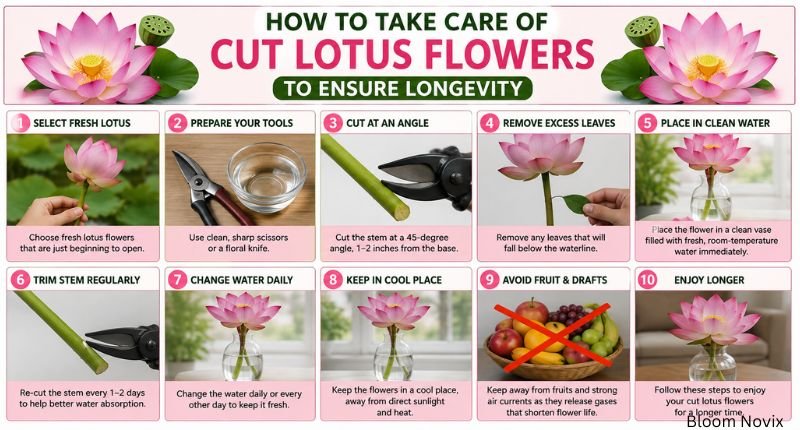
Lotus behaves differently from most cut flowers, so standard flower care advice doesn’t fully apply here. The good news is that a few specific habits make a noticeable difference to how long a bloom actually lasts once it’s cut.
Choosing the right stem matters just as much as caring for it afterward — a tightly closed, firm bud still has most of its natural three-to-five-day cycle ahead of it, the same cycle that applies whether the flower is rooted in a pond or standing in a vase.
- Hydrate immediately: place stems in clean, room-temperature water as soon as they arrive
- Fold open for events: gently open blooms by hand 20 minutes per flower, timed to the occasion
- Stagger at home: open a third of your stems first, then more every 3–4 days for longer overall enjoyment
- Change water daily: lotus stems are more prone to bacteria than most cut flowers
- Avoid drafts: air vents and open windows cause early wilting and darkened petals
- Control temperature: keep at 20–22°C (68–72°F), or refrigerate briefly at 13°C to pause blooming
One detail carries over from the pond: lotus opens each morning and closes by early afternoon, even as a cut flower. That’s why the fullest, most photogenic bloom always happens earliest in the day, whether you’re viewing it in a garden or on your own table.
See More: April Birth Flowers
Conclusion
Lotus flower season is far more layered than a single line on a calendar. It’s shaped by temperature, rainfall, and centuries of adaptation — and along the way, it’s full of small surprises: flowers that warm themselves, seeds that sleep for a thousand years, and leaves that clean themselves without any help.
Whether you plant a rhizome this spring, plan a trip around July’s peak bloom, or simply keep a bouquet alive a little longer than expected, the pattern holds everywhere this flower grows: it blooms exactly when conditions allow, never rushed, which is likely why it has long stood for patience and renewal.
Frequently Asked Questions
Can Lotus Flowers Bloom In Colder Climates?
Yes, but with limits — lotus needs sustained warmth, so in colder climates it typically blooms only through summer, with a shorter window than in tropical regions. The rhizome survives winter as long as it stays below the frost line.
How Often Should I Water Lotus Flowers In A Pond?
Rather than frequent watering, focus on maintaining a steady depth of 30–45 cm, topping up for evaporation during hot weeks. Checking levels every few days in peak summer prevents stress on the rhizome during active flowering.
How Long Do Cut Lotus Flowers Last?
With daily water changes, stable room temperature, and protection from drafts, cut lotus can last anywhere from four days to nearly two weeks, depending on whether blooms are opened all at once or in stages.
Can I Grow Lotus Flowers Indoors?
Yes, in large, drainage-free containers positioned near the brightest window available, or under a grow light, since indoor lighting rarely matches the direct outdoor sun this plant is naturally adapted to.
Where Do Lotus Flowers Grow Best?
Lotus thrives in warm, shallow, nutrient-rich freshwater with full sun — ponds and lakes across India, China, Vietnam, Thailand, and Indonesia, plus warmer pockets of North America and Europe each summer.
What’s So Special About A Lotus Flower?
Beyond its appearance, the lotus regulates its own internal temperature, self-cleans its leaves at a microscopic level, and produces seeds that can stay viable for over a thousand years — biology that has made it a lasting symbol of purity and renewal across several cultures.
What Month Is A Lotus Flower?
There’s no single universal month. July and August mark peak bloom across most of the Northern Hemisphere, while tropical regions like Singapore and Thailand can see lotus blooming nearly year-round.
Does Lotus Flower Season Bloom Twice?
Not exactly twice — in warm climates, a single plant produces multiple overlapping waves of blooms within one season, as new buds replace older ones that have finished their cycle. These same ponds also support frogs, dragonflies, and pollinators throughout the season, making the bloom important for the whole ecosystem, not just its looks.

BloomNovix is managed by an experienced team of content writers and SEO specialists with 4+ years of expertise in gardening and plant care. We provide well-researched guides, gardening tips, and insights on floral meanings to help plant lovers grow their indoor and outdoor gardens with confidence.



2 thoughts on “Lotus Flower Season: 15 Amazing Blooming Facts You Shouldn’t Miss”