Answer a few simple questions and discover a flower that matches your preferences and special occasion.
Picture a quiet forest path in early spring. You look up, and hundreds of tiny white bells sway gently above your head, catching the light like drops of silver. That first glimpse is often how people fall in love with the silverbell flower meaning before they even know its name. It feels delicate, almost secretive, as if the tree is whispering rather than shouting for attention.
This guide walks you through everything you need to know about this graceful bloom. You will learn what the flower symbolizes, where it grows best, how to care for it season by season, and whether it is safe to touch or taste. By the end, you will know this tree better than most gardeners ever do.
Many people first search for the silverbell flower meaning after spotting one on a hiking trail or in a neighbor’s yard, without knowing what tree they just saw. This guide fills in every gap that question leaves behind, from symbolism to soil type to pruning schedules, so you never have to guess again.
What Is a Silverbell Flower?
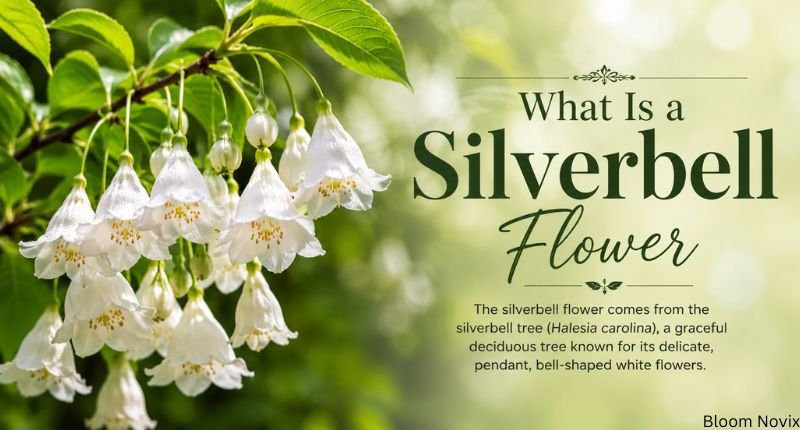
The silverbell flower belongs to the genus Halesia, a small group of flowering trees and shrubs in the storax family. You will recognize it instantly by its shape. The blooms hang downward in small clusters, like tiny white lanterns strung along bare branches. Like other flowering plants such as oleander, silverbell is also appreciated for its distinctive blooms and ornamental beauty.
Here is what makes this flower stand out:
- The petals form a soft bell shape, not a flat, open bloom
- Flowers appear before the leaves fully unfurl
- Clusters usually hold between one and five blooms
- Color ranges from pure white to a soft blush pink
Gardeners often plant silverbell trees specifically for this bloom. Few spring-flowering trees create the same soft, cascading effect.
Quick Facts About the Silverbell Flower
| Feature | Details |
| Genus | Halesia |
| Family | Styracaceae (storax family) |
| Common names | Silverbell, silver bell tree, opossum-wood |
| Flower color | White, occasionally pink |
| Flower shape | Bell-shaped, pendulous |
| Bloom season | Spring (March to May) |
| Mature height | 30–40 feet |
| Growth habit | Deciduous shrub or small tree |
| Wildlife value | Attracts bees, seeds eaten by squirrels |
Carolina Silverbell Flower: What Does It Look Like?
The Carolina silverbell is the most widely grown species, and its flower is the reason why. Each bloom dangles below the branch rather than facing upward, so you often see it best from underneath, looking up through the canopy.
You will notice:
- Dark green, toothed leaves that frame the white blooms
- Flowers that open in loose clusters along last year’s growth
- A soft, almost translucent quality to the petals in bright sunlight
- Four-winged seed pods that follow the flowers and stay on the tree into winter
The overall effect is delicate rather than showy. This tree does not compete with bold spring bloomers like magnolia or cherry blossom. Instead, it offers something quieter and, for many gardeners, more memorable.
How Big Does Carolina Silverbell Get?
A mature Carolina silverbell typically reaches 30 to 40 feet tall, with a canopy nearly as wide. Growing conditions and pruning can shift this range slightly in either direction.
This moderate size makes the tree a practical choice for smaller yards. You get a genuine flowering tree without the space demands of an oak or a maple. Many homeowners use it as a specimen tree near a patio, where the hanging blooms can be enjoyed up close during a morning coffee or evening walk.
Silverbell Flower Meaning
The silverbell flower meaning is not fixed in a single, ancient tradition the way rose flower or lily meanings are. Instead, its symbolism grows out of the way the flower actually looks and behaves in nature.
People commonly associate the silverbell flower with:
- Grace — the soft, hanging form suggests quiet elegance rather than boldness
- Renewal — it blooms early in spring, often before the leaves appear
- Gentleness — the pale color and delicate shape feel soft, not dramatic
- Humility — the flower faces downward instead of reaching upward, unlike most blooms
- Quiet joy — small clusters of bells evoke the idea of soft celebration
Unlike Victorian-era flowers with rigid symbolic dictionaries, silverbell’s meaning is interpretive. Gardeners and writers read it through its physical traits rather than a fixed cultural code. This makes it a flexible flower to give or plant when you want to express something soft-spoken rather than loud.
Think about where this tree naturally grows: quiet stream banks, shaded forest coves, and moist woodland slopes. That setting shapes its symbolism as much as the flower itself. A tree that thrives in overlooked corners of the forest, rather than open, sunlit fields, naturally becomes linked to modesty and understated strength. Many gardeners plant it in memory gardens or reflection spaces for exactly this reason, choosing a bloom that feels calming rather than celebratory.
Silverbell Flower Meaning: Spiritual Significance
Beyond garden symbolism, many people connect the silverbell flower to spiritual ideas rooted in its bell shape. Bells across cultures often represent awakening, clarity, and announcement — a call that something important is beginning.
Applied to this flower, that symbolism translates into:
- A signal of new beginnings, since it blooms at the start of spring
- A reminder to stay humble, since the flower hangs downward instead of standing tall
- A symbol of inner peace, thanks to its soft color and quiet presence in the woods
Some gardeners plant silverbell trees near meditation spaces or quiet corners of the yard specifically for this reason. The tree does not demand attention. It rewards people who slow down enough to notice it.
Does Silverbell Flower Have a Scent?
Silverbell flowers carry a light, sweet fragrance, though it is far more subtle than flowers like lilac or jasmine. You typically need to stand close to the tree, ideally on a still, warm spring day, to notice it at all.
Bees clearly detect this scent from a distance, which is part of why the tree is valued as an early-season nectar source. For humans, the fragrance adds a gentle, pleasant note to a woodland garden without overwhelming other spring scents nearby.
Read Also: 20 Amazing Blue Flowers and Their Meanings
Where Does Carolina Silverbell Grow?
Carolina silverbell is native to the southeastern United States, including parts of North Carolina, South Carolina, Georgia, Tennessee, Alabama, Virginia, West Virginia, and Kentucky.
In the wild, you will typically find it growing:
- Along stream banks
- In forest understories, beneath taller trees
- On moist ravine slopes
- In mountain coves with rich, shaded soil
Outside its native range, gardeners have successfully grown it in New England, parts of California, and across much of Europe. It adapts well as long as the basic soil and moisture needs are met.
How to Grow a Silverbell Tree
Growing a silverbell tree successfully comes down to recreating its natural woodland habitat as closely as possible.
1. Choose the Right Light
Silverbell trees grow well in full sun to partial shade. In warmer regions, a spot with morning sun and afternoon shade produces the healthiest blooms and reduces stress on the tree during hot summer months.
2. Provide Moist, Well-Drained Soil
This tree does not thrive in dry, compacted ground. Aim for soil that stays:
- Consistently moist but never waterlogged
- Rich in organic matter
- Loamy in texture
- Slightly acidic
Adding compost at planting time helps recreate the rich forest soil this tree naturally prefers. A simple test many gardeners use: dig a small hole, fill it with water, and check how long it takes to drain. If water sits for more than a few hours, the site needs amending with organic matter or a different location altogether, since standing water is one of the fastest ways to stress or kill a young silverbell.
3. Give It Enough Room
Always plan for the tree’s mature size, not its size at the nursery. A 30 to 40-foot canopy needs distance from buildings, fences, and other trees. Crowding early on leads to lopsided growth and weaker blooms later.
4. Water During Establishment
Young trees need steady moisture while roots develop. Water deeply whenever the topsoil starts to dry out, rather than watering lightly every day. A 2 to 3-inch layer of mulch around the base helps hold moisture and keeps roots cool, but keep mulch pulled back from the trunk itself to prevent rot.
Most silverbell trees need this closer attention for roughly the first two growing seasons. After that, established roots reach deep enough to handle short dry spells without extra help, and you can shift to a lighter, occasional watering routine except during extended droughts.
Silverbell Tree Care Calendar (Season by Season)
Ongoing care matters just as much as the initial planting. A simple season-by-season routine can help keep your silverbell tree healthy and encourage beautiful blooms year after year. If you enjoy learning about flowers and their seasonal meanings, you can also explore the August birth flower and discover what it symbolizes.
| Season | Key Care Tasks |
| Spring | Watch for blooms, water regularly, apply a balanced fertilizer once new growth starts |
| Summer | Water deeply during dry spells, refresh mulch, watch leaves for pest activity |
| Fall | Rake and compost fallen leaves, reduce watering as growth slows, check for winged seed pods |
| Winter | Avoid pruning during hard frost, protect young trees with extra mulch, inspect bark for damage |
Following this simple rhythm prevents most of the common problems silverbell owners face, especially during the tree’s first three years in the ground.
How to Propagate a Silverbell Tree
You can propagate a silverbell tree from seed or softwood cuttings, though seeds require patience.
From seed:
- Collect the winged seed pods in fall once they turn brown
- Store seeds in a cool, moist environment for several months to break dormancy
- Sow in spring in loose, well-drained soil
From cuttings:
- Take softwood cuttings in early summer from healthy new growth
- Dip the cut end in rooting hormone
- Place in a moist, well-draining potting mix until roots form
Cuttings tend to root faster and produce a tree that matches the parent plant more closely than seed-grown trees.
Common Pests and Diseases of Silverbell
Silverbell is a fairly low-maintenance tree, but a few problems can appear if growing conditions slip.
- Scale insects — small bumps on stems that weaken new growth; treat with horticultural oil
- Leaf spot fungus — dark spots on foliage, usually linked to excess moisture on leaves; improve air circulation
- Root rot — caused by soil that stays too wet for too long; correct drainage to prevent this
- Aphids — occasional but rarely serious; a strong water spray usually clears them
Most issues trace back to poor drainage or overcrowding, so getting the planting site right from the start prevents the majority of problems.
A useful habit is a quick monthly check during the growing season. Walk around the tree, look under a few leaves, and inspect the base of the trunk for soft or discolored bark. Catching scale or early leaf spot in the first few weeks is far easier than treating a tree that has already lost significant foliage.
Best Uses for Silverbell in Landscape Design
Beyond a single specimen tree, silverbell works well in several landscape roles that many guides overlook.
- Woodland edge planting — use it to soften the transition between a lawn and a wooded area
- Understory layering — plant it beneath taller shade trees like oak or hickory, mimicking its natural habitat
- Focal point near seating areas — position it where the hanging blooms are visible from below, such as near a bench or patio
- Privacy screening in groups — space several trees to form a soft, informal border rather than a rigid hedge
Because the flowers face downward, placement matters more with this tree than with most flowering species. A silverbell planted on a slope, or near a path that runs slightly below the tree line, shows off the blooms far better than one planted on flat, open ground.
When Does the Silverbell Flower Bloom?
Carolina silverbell typically blooms from March through May, depending on your region and that year’s weather. Warmer climates see flowers earlier in this window, while cooler areas bloom closer to late April or May.
Flowers usually appear before or alongside new leaf growth, which makes the bare branches look almost frosted with white for a short but memorable stretch each spring.
Is the Silverbell Flower Edible?
No, silverbell flowers should not be eaten. There is no reliable, species-specific evidence confirming they are safe for human consumption.
Bees visit the flowers and squirrels eat the seeds, but that does not make any part of this plant safe for people. Wildlife often tolerates or processes plant compounds differently than humans do.
To stay safe:
- Never use silverbell flowers as a food garnish
- Do not assume a flower is edible just because animals interact with it
- Avoid tasting any part of an unidentified Halesia plant
- Choose flowers with confirmed culinary safety if you want an edible garden feature
Are Silverbell Seeds Edible?
Silverbell seeds feed wildlife, particularly squirrels, but they are not established as safe for human consumption. There is no dependable culinary information supporting their use as food. It is best to leave the seeds for wildlife and avoid eating them yourself.
Are Silverbell Flowers Poisonous?
There is no strong documented evidence that silverbell flowers are highly toxic, but they are also not confirmed safe. This uncertainty is exactly why caution matters.
- Keep young children from putting flowers or seeds in their mouths
- Watch pets closely if they tend to chew on garden plants
- Contact a poison control center or veterinarian if ingestion causes symptoms like vomiting or drooling
When a plant’s safety has not been clearly studied, the safest approach is simple: admire it, but do not eat it.
Silverbell Flower and Wildlife
This tree earns its keep in a garden well beyond its looks. Bees rely on silverbell as an early nectar source, arriving in numbers as soon as the blooms open. In some regions, beekeepers specifically value it as a strong early-season honey plant, making it a valuable choice for gardens with native wildflowers.
Squirrels feed on the seeds later in the year, and the tree’s branching structure offers shelter for small birds. If you are building a wildlife-friendly yard, silverbell checks several boxes at once: pollinator support, seed source, and shelter, all from a single tree.
Carolina Silverbell vs. Other Silverbells
“Silverbell” is not one single plant. Several species share the name, and telling them apart matters if you want the exact look or growing conditions you expect.
Carolina Silverbell
Halesia carolina is the most commonly planted species. It offers the classic white, bell-shaped bloom and grows into a small to medium tree, making it the default choice for most home gardens.
Two-Wing Silverbell
Halesia diptera gets its name from its distinctive two-winged seed pods, different from the four-winged pods of Carolina silverbell. Its flowers tend to be slightly larger, and the tree often grows a bit more shrub-like.
Little Silverbell
Halesia parviflora, sometimes called Florida silverbell, produces smaller flowers and stays more compact overall. It suits smaller gardens where a full-sized Carolina silverbell would feel too large.
Silverbell Flower vs. Lily of the Valley: What’s the Difference?
Both flowers share a white, bell-shaped look, which leads to frequent confusion, especially in photos. But they are not related, and their growing habits differ sharply.
| Feature | Silverbell Flower | Lily of the Valley |
| Plant type | Tree or shrub | Low-growing perennial |
| Height | 30–40 feet | 6–12 inches |
| Bloom location | Hangs from branches | Rises on short stalks near the ground |
| Toxicity | Unconfirmed, treat with caution | Confirmed toxic if ingested |
| Growing style | Woodland tree | Ground cover, shade garden |
If you spot bell-shaped white flowers close to the ground in a shaded bed, you are almost certainly looking at lily of the valley, not silverbell. Silverbell only appears on woody branches, well above soil level.
Other Common Names for Silverbell (Including Cockleshell Tree)
Regional naming adds another layer of confusion. Depending on where you live, you might hear this tree called:
- Silverbell tree
- Opossum-wood
- Cockleshell flower or cockleshell tree, a name sometimes used regionally for Halesia species
- Snowdrop tree, though this name is more accurately used for a related but distinct species
Always check the scientific name, Halesia, when buying a tree or researching care instructions. Common names can overlap across completely different plants.
Best Companion Plants for Silverbell Trees
Because silverbell flower naturally grows in woodland settings, it pairs well with other shade-tolerant, moisture-loving plants.
Strong companion choices include:
- Ferns, which enjoy the same moist, shaded soil
- Hostas, for texture beneath the canopy
- Azaleas and rhododendrons, which share similar acidic soil preferences
- Trillium and other native woodland wildflowers, for a natural forest-floor look
- Dogwood trees, which bloom around the same time and share growing conditions
Grouping these plants together recreates the layered, woodland feel silverbell naturally belongs to, rather than isolating it in an open lawn.
A common mistake is planting silverbell alone in the middle of a mowed lawn. It survives there, but it rarely thrives, since lawn soil is usually compacted and far drier than the loose, organic-rich ground this tree evolved in. Surrounding it with even a small bed of shade-loving companions makes a noticeable difference in bloom quality within just a few seasons.
Why Gardeners Like the Silverbell Tree
Several practical reasons keep this tree popular among experienced gardeners, not just beginners drawn to its looks.
- The flowers are genuinely distinctive, unlike anything else blooming in early spring
- Its manageable size fits smaller residential yards
- It supports pollinators at a time of year when food sources are still limited
- Fall and winter interest continues through its unusual winged seed pods
- It requires relatively low maintenance once established in the right spot
For gardeners who want more than just a pretty bloom, silverbell offers a tree that contributes to the wider garden ecosystem all year long.
Gardeners who have grown this tree for several years often mention the same thing: the payoff builds slowly. The first spring bloom is modest, but by year four or five, once the canopy fills out, the tree can produce a genuinely dense curtain of white bells that stops visitors in their tracks. Patience with this species tends to pay off far more than with fast-growing, short-lived flowering trees.
Frequently Asked Questions
What is a silverbell flower?
It is the white, bell-shaped bloom of trees in the genus Halesia. These flowers hang in small clusters and open in early spring, before or alongside new leaves.
What does the silverbell flower mean?
The silverbell flower meaning centers on grace, gentleness, and renewal. Its soft, downward-facing shape is often read as a symbol of quiet elegance rather than bold beauty.
Is Carolina silverbell the same as silverbell?
Carolina silverbell is one specific species within the wider silverbell group. Other species, like two-wing and little silverbell, also share the common name.
Is the silverbell flower edible?
No, it should not be treated as edible. There is no reliable evidence confirming it is safe for humans to eat.
Are silverbell flowers poisonous to humans or pets?
Toxicity has not been clearly confirmed either way. Because of this uncertainty, it is safest to keep children and pets from chewing on the flowers or seeds.
Does the silverbell flower have a fragrance?
Yes, it has a light, sweet scent. The fragrance is subtle and usually noticeable only up close, on calm spring days.
When does Carolina silverbell bloom?
It typically blooms from March through May. Exact timing shifts slightly depending on regional climate and spring weather.
How tall does Carolina silverbell get?
A mature tree usually reaches 30 to 40 feet. Growing conditions and pruning habits can push this range slightly higher or lower.
Is Carolina silverbell easy to grow?
Yes, once planted in the right conditions. It needs moist, well-drained soil and partial shade to thrive with minimal upkeep.
Do bees like Carolina silverbell flowers?
Yes, bees are strongly attracted to the blooms. The tree serves as an important early-season nectar source in many regions.
How is silverbell flower different from lily of the valley?
Silverbell grows on a tree, while lily of the valley grows close to the ground. They share a similar bell shape but come from completely unrelated plant families.
Can you grow a silverbell tree from seed?
Yes, though it takes patience. Seeds need a cold, moist storage period before they will germinate reliably in spring.
Final Words
The silverbell flower meaning captures something many showier blooms miss entirely: the quiet power of restraint. This tree does not need enormous petals or bright colors to leave an impression. A single walk beneath a blooming silverbell, looking up through hundreds of small white bells, tends to stay with people long after the flowers fade.
Beyond its beauty, this tree earns its place through real function. It feeds early-season bees, shelters wildlife, and asks for relatively little in return once it settles into the right spot. Whether you are planting one for its symbolism, its woodland charm, or simply its manageable size, silverbell rewards patient, thoughtful gardeners more than almost any other spring-flowering tree.

BloomNovix is managed by an experienced team of content writers and SEO specialists with 4+ years of expertise in gardening and plant care. We provide well-researched guides, gardening tips, and insights on floral meanings to help plant lovers grow their indoor and outdoor gardens with confidence.