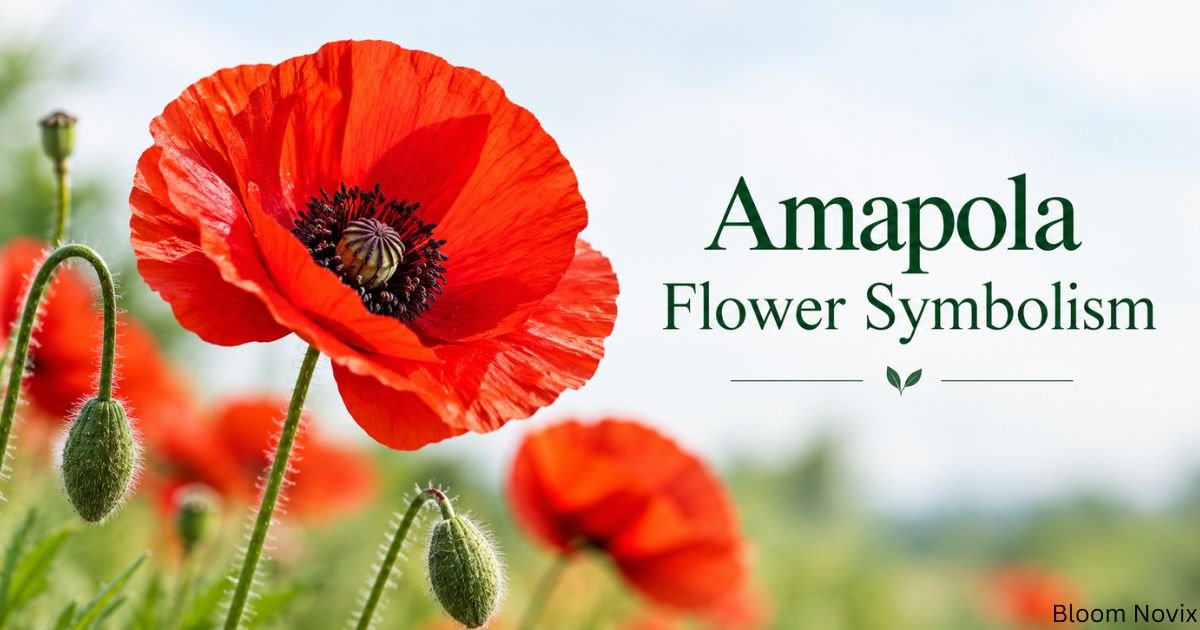
Picture a green field in spring, covered with tiny red blooms moving gently in the wind. The amapola has a simple beauty that can make you stop and look twice. Its thin petals may seem delicate, but the flower carries a long and interesting story.
Amapola flower symbolism is often connected with love, sleep, remembrance, hope, and the fragile side of life. This amapola poppy can represent different things depending on its color, culture, and the feelings attached to it.
Red amapolas may suggest passion, love, or remembrance, while white blooms can be linked with peace and innocence. Some colors also carry more personal or modern meanings. That is what makes this poppy flower so interesting—its message is not limited to one simple idea.
In this guide, we will explore amapola flower meaning, color symbolism, spiritual connections, dreams, tattoos, history, and more. You will also discover why this delicate flower has become such a meaningful symbol in different parts of the world.
What Is an Amapola Flower? Meaning of the Name and Origins
“Amapola” is simply the Spanish word for poppy. It is not the name of just one flower. Spanish speakers use amapola for different kinds of poppies, so the exact flower can depend on the species being discussed.
When people hear the word, they often picture the red corn poppy, Papaver rhoeas. It grows wild across Europe, North Africa, and parts of Asia. Its delicate red petals have a soft, crumpled-paper look. The blooms are short-lived, often opening for only a day or two.
But the amapola family is more varied than that. The golden California poppy and the blue Himalayan poppy are also part of the wider poppy group. They look very different from the familiar red bloom, and their symbolism can differ too.
So before exploring amapola flower symbolism, it helps to know which poppy you are actually looking at.
- Name origin: Spanish term for poppy
- Best-known type: red corn poppy
- Family: Papaveraceae
- Bloom time: spring to early summer
Amapola Flower Symbolism: Core Meanings at a Glance
At its heart, the amapola can represent life and death. Its bloom appears quickly and does not last long. That short life can remind us to appreciate the moments we have. It is one reason the flower has found a place in poetry and literature.
The amapola is also linked with hope and renewal. Poppy seeds can remain dormant in the soil for a long time. When the ground is disturbed, they may grow again and bring fresh blooms to the surface. A once-bare landscape can turn red with poppies. It is a beautiful reminder of resilience and strength.
The flower can carry other meanings too, including peace and remembrance, passion and love, and dreams and emotions. Color can change the feeling behind the bloom, giving each amapola its own symbolic touch.
| Color | Main Meaning | Feeling It Carries |
| Red | Love, remembrance, sacrifice | Deep and emotional |
| White | Peace, comfort, purity | Calm and quiet |
| Yellow | Success, wealth, joy | Warm and bright |
| Blue | Mystery, rarity, the impossible | Dreamy and distant |
Red Amapola Flower Symbolism
Red is the classic amapola. Its meaning has two sides. One side is passion and love. The other side is grief and sacrifice. Both sides share one thing: strong feeling.
Red poppies became the emblem of war memory after World War I. They grew on torn battlefields in Flanders. Soldiers saw them bloom among the graves. Today, many people wear one each November to honor the fallen.
In daily life, a red amapola can say, “I feel this deeply.” Lovers once used it to show devotion. Mourners used it to show loss. If you give one, tell the person what you mean. The message is strong, so clarity matters.
- Love and deep passion
- Remembrance of the fallen
- Courage and sacrifice
- Short but intense beauty
White Amapola Flower Symbolism
The white poppy is the quiet cousin. It stands for peace, calm and innocence. It also offers comfort during hard times. The petals look soft, clean and almost glowing.
Since 1933, white poppies have also been worn as a symbol of peace. People wear them to remember all victims of war. They also wear them to say, “Let us end conflict.” Some wear them next to a red one.
In flower language, a white amapola can mean a gentle goodbye. It suits sympathy cards and peaceful gifts. It also suits anyone starting a new, calmer chapter. If red shouts, white whispers.
- Peace and non-violence
- Gentle comfort in grief
- Purity and fresh starts
- Calm sleep and rest
Read Also: Mississippi Flower Meaning
Yellow Amapola Flower Symbolism
Yellow poppies bring sunshine. They stand for joy, success and prosperity. Think of the golden glow of a morning meadow. The color alone lifts your mood.
Several yellow species exist. The Welsh poppy has soft yellow petals. The golden poppy of California glows orange-gold. Both carry the same cheerful message. They tell you good times are near.
Gift a yellow amapola to celebrate a win. It suits a new job, a new home or a new business. It also suits a friend who needs a smile. Of all the colors, yellow has the lightest mood.
- Joy and optimism
- Wealth and success
- Friendship and warmth
- New opportunities
Blue Amapola Flower Symbolism
The blue poppy is real, but it is rare. The Himalayan blue poppy grows in cool, misty mountains. Gardeners find it hard to grow. That difficulty shapes its meaning.
Because it is so hard to find, the blue amapola stands for the unreachable. It means mystery, deep longing and the impossible. Some see it as a sign of spiritual seeking. Bhutan even honors it as its national flower.
You will rarely see a true blue one in a typical garden. Many “blue” photos online are edited. Be careful when you shop for seeds. A real blue poppy needs cool air, rich soil and patience.
- Mystery and rare beauty
- The impossible made real
- Spiritual searching
- Calm and deep thought
If you enjoy learning about blue blooms, you can also explore the meanings behind different blue flowers.
Amapola Flower Spiritual Meaning
Spiritually, the amapola can be a symbol of letting go. Its delicate petals do not stay for long, but the plant continues its cycle by producing seeds for new growth. This can be seen as a reminder that an ending does not always mean the end of the story. Sometimes, it makes room for something new.
The flower is also connected with rest, sleep, and the inner world. Poppies have been associated with sleep and dreams for centuries, which gives the amapola a natural place in discussions of emotional meaning and inner reflection.
For some people, the image of a red poppy opening slowly can feel calming during meditation. It may represent releasing grief, fear, or heavy emotions. In this sense, spiritual symbolism of the amapola comes down to a gentle cycle: let go, rest, heal, and start again.
- Acceptance of change
- Healing after loss
- Deep rest and dreaming
- Trust in life’s cycles
Amapola Symbolism in Love and Relationships
In love, the red amapola speaks of strong feeling. It does not stand for a calm, safe romance. It stands for a bold, burning one. That is why poets chose it for love poems.
The amapola flower meaning in love has a gentle warning too. Poppy petals drop fast. So the flower can hint at love that needs care. A bond, like a bloom, needs attention each day.
Use it wisely as a gift. A single red one says, “You move me.” A mixed bunch says, “You bring me peace and joy.” A white one says, “I’m here for you.” Match the color to your real message.
- Red: passion and devotion
- Pink: sweet, gentle affection
- White: loyal comfort
- Yellow: happy friendship
Amapola Flower Meaning in Death, Sleep and Remembrance
Why do poppies link to both sleep and death? The answer lies in the plant itself. The opium poppy has long been used to ease pain and bring sleep. Ancient people saw sleep as death’s little sibling.
Greek and Roman art often showed sleep gods holding poppies. Gravestones also carried poppy carvings. The flower said, “Rest now.” It did not say, “Fear this.”
In modern times, the red poppy keeps this link alive. It marks days of memory, such as Remembrance Day and Memorial Day events. It reminds us that life and death share one field. And it shows that memory can bloom, too.
- Rest after a hard life
- Respect for the fallen
- Peace beyond pain
- Memory that never fades
Amapola in Spanish and Latin American Culture
In Spanish-speaking lands, “amapola” is a loved word. It is also a common girl’s name. It brings to mind red fields, spring and tender feeling. The word itself sounds like poetry.
A famous 1920 song, “Amapola,” by Spanish composer José María Lacalle, carried the flower around the world. Singers in many languages later covered it. The song tied the poppy to romance and longing. That link still lives today.
In some parts of Latin America, the word also appears in sadder stories. In regions where opium poppies grow illegally, “amapola” can point to crime and hardship. So the word holds beauty and pain together. Context tells you which meaning applies.
| Region | Common Association |
| Spain | Spring, romance, wild red fields |
| Latin America | Beauty, song, and sometimes struggle |
| UK and Commonwealth | War remembrance |
| United States | Memorial Day, California pride |
Explore More: Simple Funeral Flower Arrangements at Home
Amapola in Mythology, History and Folklore
Greek myth tells of Demeter, the goddess of harvest. When her daughter Persephone vanished, she grieved deeply. Stories say she used poppies to find sleep and ease her pain. The flower became her sacred sign.
Sleep and dream gods, such as Hypnos and Morpheus, also wore or held poppies. The Romans linked the flower to Ceres, their harvest goddess. Some reports even say ancient Egyptians placed poppy petals in tomb garlands. The flower walked beside the dead.
Folklore adds smaller tales. In parts of Europe, people believed poppies grew where blood had fallen. Farmers often saw them in grain fields and treated them as a sign of rich land. That mix of blood, bread and rest gave the poppy its mythic weight.
- Demeter: grief and harvest
- Hypnos and Morpheus: sleep and dreams
- Ceres: farmland and plenty
- Folklore: poppies from spilled blood
Amapola Flower Symbolism in the Bible and Religion
The Bible does not mention the poppy by name, so there is no verse that gives the flower an official biblical meaning. Some readers connect red wildflowers with the “lilies of the field” passage, but that is an interpretation rather than a biblical fact.
Even so, some of the themes associated with the amapola can fit Christian ideas. A flower that blooms and fades quickly can remind people of the brief nature of life. Its return each spring can also suggest hope and renewal. For some Christians, the red petals may serve as a quiet reminder of sacrifice, although this is a personal interpretation rather than a fixed religious symbol.
The meaning can be different in other faiths and traditions. Poppy seeds appear in foods, customs, and rituals in many cultures. Some traditions also use poppies in seasonal or religious celebrations. Because of these differences, it is better to look at the specific tradition before giving the flower a religious meaning. There is no single meaning that applies everywhere.
- Not named in the Bible
- Often linked to sacrifice and hope
- Meaning depends on tradition
- Best read as symbolism, not doctrine
California Poppy: The Golden Amapola and Its Meaning
Many Spanish speakers call the California poppy an amapola too. Its Latin name is Eschscholzia californica. It glows in gold and orange. In 1903, California made it the official state flower.
Its meaning leans toward freedom and beauty. Spanish explorers once saw hills lit by golden blooms. They reportedly called the land “the land of fire” in some accounts. Today, it stands for sunshine, pride and wild open space.
This flower also has a trait that adds to its story. It closes its petals at night and on cloudy days. Then it opens again with the sun. That daily rhythm shows trust, patience and renewal. It is a gentle teacher.
- State flower of California
- Symbol of freedom and sunshine
- Opens and closes with light
- A cheerful, golden amapola
Amapola Flower Dream Meaning
Dreams of poppies often point to emotion. A field of red blooms can signal strong love or a deep wish. It may also show unspoken grief. Your feelings in the dream matter most.
Picking a poppy in a dream may mean you are ready to take what you want. Seeing wilted ones may hint at fading energy. A white poppy often brings a message of peace. A yellow amapola may promise joy ahead.
Remember, dream meanings are personal. They are not strict rules. Write the dream down right away. Then ask, “What did I feel?” That answer will teach you more than any list.
- Red field: strong feeling or desire
- White poppy: peace is coming
- Wilted bloom: tired heart or needed rest
- Golden bloom: joy and luck
Amapola Flower Tattoo Meaning
Poppy tattoos are popular for good reason. They look elegant, and they carry deep meaning. Most wearers choose them to honor someone. Others choose them to mark survival.
A red design often means love, loss or memory. A white one can show peace and healing. A bold, colorful bunch can show joy in living. Some add a date or a name to make it personal.
Placement matters too. Small ones suit the wrist, ankle or behind the ear. Larger ones suit the forearm, thigh or ribs. Talk with your artist about style. Fine-line, watercolor and traditional styles all suit this flower.
- Red: love and remembrance
- White: peace and healing
- Poppy with dates: tribute to a loved one
- Poppy with a bird: freedom and hope
Amapola as the August Birth Flower and Gifting Occasions
The poppy flower is one of the two birth flowers for August. The other is the gladiolus. People born in August may enjoy its message of imagination, beauty and sleep. It suits creative, dreamy souls well.
Poppies also fit many gifting moments. Choose red for love and anniversaries. Choose white for sympathy and get-well wishes. Choose yellow for graduations and fresh starts. Add a short note to explain your color.
Fresh poppies wilt fast, so be smart. Cut the stems early in the morning. Sear the cut ends with a flame or dip them in hot water for a few seconds. This simple step helps them last longer. Or gift a poppy print, plant or seed packet instead.
- August birthdays
- Anniversaries and love notes
- Sympathy and remembrance
- Garden-lover gifts
Amapola in Art, Literature and Music
Artists have loved poppies for centuries. Claude Monet painted a bright field of red poppies in 1873. Vincent van Gogh also painted them. Georgia O’Keeffe made large, bold poppy canvases in the 1920s. Each artist saw something different.
Writers did the same. John McCrae wrote “In Flanders Fields” in 1915. That poem made the red poppy a global sign of war memory. In The Wizard of Oz, a poppy field puts the heroes to sleep. The flower works as a hook for story and mood.
Music kept the tradition. The song “Amapola” turned the flower into a love symbol. Today, poppies still appear in album art and film scenes. This long link proves how well the flower holds cultural meaning and emotional meaning together.
- Monet: color and light
- McCrae: memory and loss
- Oz: sleep and temptation
- Song: love and longing
Is the Amapola Flower Poisonous? Myths, Opium and Facts
Not every poppy is the same. The opium poppy (Papaver somniferum) contains strong compounds. These form the base of certain medicines and illegal drugs. Growing it is restricted in many countries. Always check your local laws.
The red corn poppy is much milder. It contains small amounts of other compounds. Even so, it is not a food plant. Keep pets and small children from chewing on it. The California poppy is also considered mild, but it is not a snack either.
Poppy seeds on bread are a different matter. Culinary seeds come from the opium poppy but are washed and processed. Even so, eating a lot may affect some drug tests. If you feel unsure, ask a doctor or a local plant expert.
| Poppy Type | Risk Level | Key Note |
| Opium poppy | High (legal limits apply) | Source of opiates; restricted |
| Corn poppy (red) | Low to moderate | Do not eat the plant |
| California poppy | Low | Mild; still not a food |
| Culinary poppy seeds | Low | Processed seeds; may affect drug tests |
Frequently Asked Questions
1. What is the amapola flower symbolism in simple words?
It stands for love, memory, peace and rest. The meaning shifts with color: red for passion and remembrance, white for peace, yellow for joy.
2. What does amapola mean in Spanish?
It means “poppy.” Spanish speakers use the word for many kinds of poppies, from red to golden.
3. What does a red amapola flower symbolize?
It symbolizes love, sacrifice and remembrance. Many people also wear it to honor fallen soldiers.
4. What does a white amapola flower mean?
It means peace, comfort and innocence. It is also worn as a peace symbol in remembrance events.
5. What does a yellow amapola flower represent?
It represents joy, success and prosperity. It makes a cheerful gift for new starts and wins.
6. Is the blue amapola a real flower, and what does it symbolize?
Yes, the Himalayan blue poppy is real, but it is rare. It symbolizes mystery, longing and the impossible.
7. What is the spiritual meaning of the amapola flower?
It teaches acceptance, healing and trust in life’s cycles. Its short bloom reminds you to value each moment.
8. Is the amapola flower a symbol of love or death?
Both. Red stands for passion, while its link to sleep and war memory ties it to death and remembrance.
9. What does an amapola flower tattoo mean?
It usually means love, memory, peace or survival. The color and design shape the exact message.
10. Is the amapola flower poisonous or safe to touch?
Touching most poppies is safe, but eating the plant is not. The opium poppy is the most dangerous and is legally restricted in many places.
Conclusion
The amapola flower symbolism brings together some of the most familiar parts of life: love and remembrance, hope and renewal, peace and rest. Its meaning can change with the color, culture, and personal story behind the flower. Red may speak of love or remembrance, while white can suggest peace. Yellow often feels cheerful, and blue can carry a sense of mystery and dreams.
There is no single meaning that everyone has to follow. That is part of what makes the amapola interesting. Its short-lived bloom can remind us to value the present, while its return can bring thoughts of hope and new beginnings.
Whether you grow amapolas in your garden, give them as a gift, or simply admire them in a field, their symbolism can be personal. Sometimes a small flower carries a meaning that is difficult to put into words.

BloomNovix is managed by an experienced team of content writers and SEO specialists with 4+ years of expertise in gardening and plant care. We provide well-researched guides, gardening tips, and insights on floral meanings to help plant lovers grow their indoor and outdoor gardens with confidence.







1 thought on “Amapola Flower Symbolism: Colors, Meaning & Spirituality”