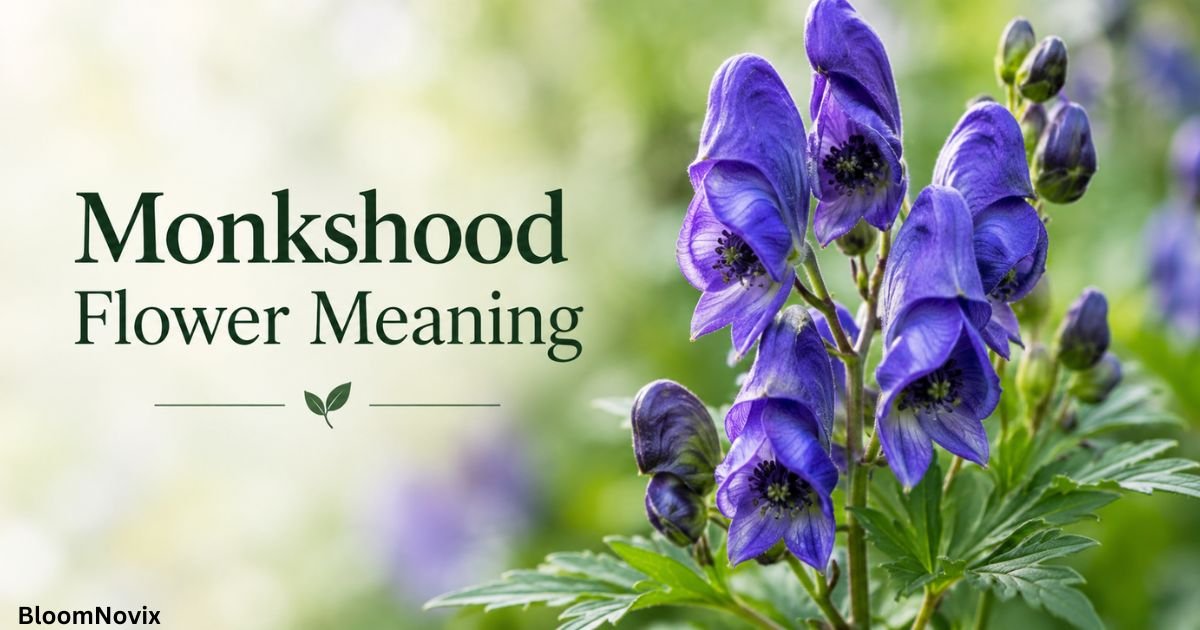
The monkshood flower meaning is closely tied to danger and caution. Its tall stems and blue-purple blooms are beautiful, but the plant itself is highly poisonous. That unusual mix of beauty and danger has shaped the way people have viewed monkshood for centuries.
Monkshood is also known as wolfsbane and aconite, names that come with their own history and folklore. Its hood-shaped blooms have been associated with mystery, chivalry, and strength, while different flower colors can bring slightly different meanings.
What makes monkshood stand out is the way its appearance and nature seem to tell two different stories. It looks delicate in the garden, yet it needs to be treated with care. Its history, symbolism, and poisonous nature have all helped give this flower its distinctive place in flower language.
Monkshood Flower Meaning: Origin and Name
The name monkshood comes from the unusual shape of its bloom. One of the upper petals curves over the others, looking much like the hood of a monk’s robe. The flower can also resemble a small helmet, which helps explain why some of its older names are connected with knights and warriors.
Its scientific name, Aconitum, has roots in ancient Greek. Early Greek writers used the word akoniton for a poisonous plant. The exact origin of the word is still uncertain, so it is better not to treat one explanation as the definite answer.
Over the years, monkshood has collected several memorable names, including wolfsbane, aconite, devil’s helmet, friar’s cap, and queen of poisons. Some describe its shape, while others reflect its long association with poison and old folklore. Together, these names show why this striking hooded flower has always carried a slightly mysterious reputation.
Monkshood vs Wolfsbane vs Aconite: Are They the Same Plant?
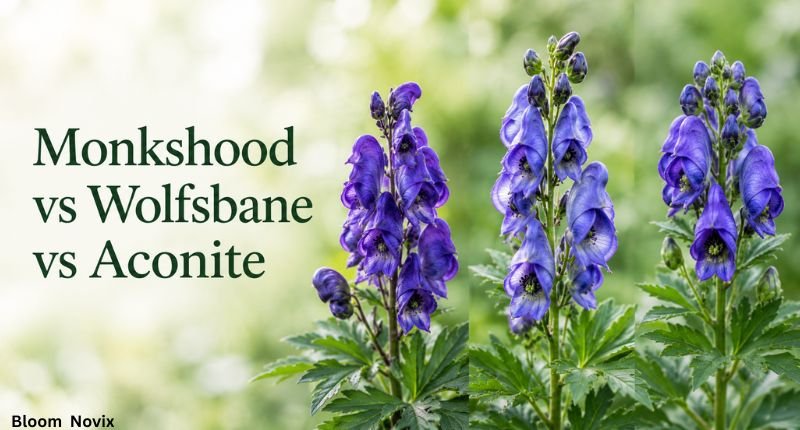
Many people think these three words mean the same thing. They overlap, but each word points to something a little different. Monkshood is the everyday name for the garden species of the genus Aconitum.
Aconite names the plant, and old texts also use it for the toxic extract. Wolfsbane often covers the whole genus in folklore. Strictly, botanists link the name to the yellow-flowered Aconitum lycoctonum, whose Latin name means “wolf-killing.”
Here is a simple way to remember the difference:
- Monkshood: the common name for blue-purple garden Aconitum.
- Aconite: the genus name, and the old word for its poison.
- Wolfsbane: the folklore name, often used for the whole group.
Monkshood in Victorian Flower Language
Victorians loved to send secret messages with flowers. They used small bouquets and dictionaries of flower language to say what polite speech could not. A single stem could praise, flirt, or warn.
Monkshood carried one of the sharpest warnings in those books. Its message was close to “beware, a deadly foe is near.” The meaning came straight from the plant’s real poison.
Not every book agreed, though. Some lists linked the plant to knightly courage, and a few tied aconite to a distrust of people. Always check which author you read, because monkshood Victorian flower meaning changes from page to page.
Botanical Foundations & Profile
Monkshood belongs to the buttercup family, Ranunculaceae. It grows from thick, dark roots and sends up tall flower spikes in late summer. The leaves are deeply lobed and glossy, which gives the plant a bold, sculpted look.
The hood on each flower has a purpose. It hides the nectar parts and guides bumblebees to the right spot. Few other insects can reach inside, so bumblebees do most of the pollinating.
| Feature | Detail |
| Scientific name | Aconitum (best known: Aconitum napellus) |
| Plant family | Ranunculaceae (buttercup family) |
| Native range | Cool regions of Europe, Asia, and North America |
| Species count | Around 250 |
| Height | About 3 to 4 feet, some taller |
| Bloom time | Late summer through fall |
| Hardiness | Roughly USDA zones 3 to 7 |
| Best site | Partial shade with rich, moist soil |
| Toxicity | Highly toxic in every part |
History & Cultural Timeline
Monkshood has a long paper trail. People wrote about it long before anyone grew it for pleasure. Its history reads like a warning that kept getting updated.
- Ancient world: Greek and Roman writers described its deadly power.
- Middle Ages: Monastery herbals studied it, mostly to help readers avoid it.
- Old hunting lore: Stories say hunters coated bait and weapons to kill wolves.
- Victorian era: Gardeners grew it for its color, and poets used it as a warning symbol.
- Today: It thrives in shade borders, gothic gardens, and cottage plantings.
Many real poisonings came from simple mistakes. The thick root looks a little like horseradish, and people dug it up by accident. That is why old garden books repeat the same advice: know your plant.
Symbolism Deep-Dive
Monkshood carries three big ideas. Each one grows from the plant’s looks or its poison. Together they explain why this flower still grabs attention.
Danger
Every part of the plant holds the toxin aconitine. This natural poison shaped the plant’s role as a warning flower. People read it as a sign to stop, look closely, and step back.
The danger’s meaning goes beyond poison. It also stands for a threat that looks harmless at first. That idea gives monkshood flower danger meaning its emotional punch.
Chivalry
The flower stands tall and straight, with a helmet-like hood on top. Old writers saw a knight on guard. That image tied the plant to chivalry and honor.
This meaning softens the dark side. It says that strength can protect as well as harm. Many readers link this view to monkshood flower meaning protection.
Mystery
The deep blue-purple color feels cool and secretive. The hood hides the inner parts of the bloom. You must look closely to see what sits inside.
The plant also loves shade, where light is low and shadows are long. That setting adds to its mysterious flower symbolism. No wonder gothic gardeners love it.
Monkshood Flower Spiritual Meaning
Spiritually, monkshood teaches respect for boundaries. It reminds you that not everything beautiful is safe to hold. Many modern writers use it as a symbol of wise caution.
Others see it as a guardian plant. Its helmet shape suggests a shield, and its poison suggests a locked gate. In this view, monkshood spiritual meaning centers on protection from harm and false friends.
Some spiritual readers also link it to shadow work. They say it asks you to face hidden fears without fear of the dark. These ideas come from modern interpretation, not ancient doctrine.
- Boundaries: protect your energy and say no.
- Discernment: look beneath a pretty surface.
- Protection: guard your home, mind, and heart.
- Respect: honor the power of nature.
Meaning by Color
Color changes the mood of monkshood symbolism. Most people picture the classic deep blue-purple. Garden varieties also come in white, yellow, pink, and two-tone shades.
The deeper the color, the stronger the warning feels. Blue monkshood meaning and purple monkshood meaning both lean toward danger and hidden power. Lighter shades add a twist of false calm.
Color Meanings & Cultural Safety Matrix
Colors carry symbolic weight, but the plant itself does not change. Every shade holds the same poison. Use the table below as a guide for both meaning and caution.
| Color | Main Meaning | Safety Note |
| Deep blue or purple | Danger, hidden power, mystery | The classic and most feared form |
| White | False purity, a quiet warning | Looks gentle, equally toxic |
| Yellow | Caution, wary courage | Often tied to wolfsbane lore |
| Pink or two-tone | Charm that masks a threat | Rare, still fully toxic |
Monkshood Flower Meaning in Love and Relationships
In love and relationships, monkshood flower meaning is often connected with caution. Its poisonous nature has made it a symbol of hidden danger, so it can represent a relationship that looks beautiful on the outside but may cause harm underneath.
Because of this, monkshood can be associated with betrayal, jealousy, or an unhealthy relationship. It can also suit the idea of forbidden or complicated love, especially when strong feelings come with real risks. These meanings are more symbolic than traditional, but they fit the flower’s long history of danger and mystery.
There is also a softer interpretation. Its old connection with knights and protection can give monkshood a meaning of loyalty and strength. In this sense, it may represent someone who stands by a loved one and protects them when things become difficult.
- A warning about deceit or hidden harm
- A symbol of an unhealthy relationship
- A sign of complicated or risky love
- A symbol of loyalty, strength, and protection
Global Traditions & Literary Impact
In Europe, folklore tied wolfsbane to wolves and werewolves. Villagers told tales of herbs that could repel or harm wild beasts. These stories made the plant a star of poisonous plant folklore.
Asia has its own long story. Hunters in some mountain regions used aconite on arrow tips. Traditional medicine in parts of Asia also uses carefully processed forms, under strict expert control.
Writers love the plant too. John Keats names wolf’s-bane in his poem “Ode on Melancholy,” as a symbol of dark feeling. Shakespeare mentions aconitum in Henry IV, Part 2, and J.K. Rowling puts it in the Wolfsbane Potion in Harry Potter. This is how monkshood flower symbolism in literature keeps growing.
Monkshood in Greek Mythology and the Legend of Hecate
Greek myth gives monkshood a dramatic birth story. In one famous tale, the hero Heracles drags the beast Cerberus from the underworld. Foam from the dog’s mouth hits the ground, and aconite sprouts from the spot.
Another myth features the sorceress Medea. She tries to poison the hero Theseus with aconite at a feast. The plot fails, but the story fixed the plant in Greek memory as a tool of betrayal.
Ancient writers also linked aconite to Hecate, the goddess of magic and crossroads. She ruled night, ghosts, and secret knowledge. That bond is why monkshood mythology feels so dark and powerful.
Monkshood Flower Meaning in Witchcraft and Magic
Old witchcraft folklore treats monkshood as a plant of power and fear. Stories link it to night rituals, wolves, and shape-shifting. Many of these tales come from fear and rumor, not proof.
Modern pagans and fantasy fans use it as a symbol instead. They think of protection, banishing, and the line between life and death. They keep the real plant out of ritual use, because the poison is too risky.
If you love the theme, choose safe ways to honor it. Draw it, paint it, or use a print or a silk flower. Never burn, brew, or handle the real plant for magic.
Monkshood Flower Dream Meaning
Dream books treat monkshood as an alert from your mind. Seeing it may mean a hidden threat sits close by. It can also point to a person you should not trust yet.
Details change the message. A blue bloom may point to your intuition. A white bloom may suggest someone hides a harsh motive behind kindness.
These are popular readings, not science. Use them as prompts for reflection, not as facts.
- Picking the flower: you face a risk on purpose.
- A wilting plant: a threat starts to fade.
- A garden full of monkshood: you feel surrounded by pressure.
- Giving it to someone: you want to warn them.
Monkshood Flower Tattoo Meaning
A monkshood tattoo says beauty and danger can live together. Wearers often choose it to show survival after hardship. It also signals that you guard your boundaries.
The shape works well in ink. The hooded bloom makes a bold outline, and the tall spike fits arms, ribs, and calves. Blackwork and fine-line styles both look sharp.
Pair it with other symbols to shape the story. A wolf adds a link to wolfsbane lore. A moon adds mystery, and a skull adds a warning.
- Small and simple: a single hooded bloom on the wrist.
- Bold and dark: a full spike in blackwork on the forearm.
- Soft and floral: blue-purple watercolor accents.
Economic, Culinary, and Medicinal Uses
Monkshood has no place on your plate. Every part of the plant is toxic, including the roots, leaves, and seeds. The roots can be especially confusing because they may look similar to horseradish, which has led to accidental poisonings.
Monkshood also has a long and complicated history in traditional medicine. Some traditional systems used specially prepared aconite under expert supervision, but the plant is extremely dangerous when used incorrectly. Raw monkshood or homemade preparations can cause serious poisoning, so it should never be used as a home remedy.
Today, monkshood is mainly grown as an ornamental garden plant. Its tall blooms bring color to shady beds in late summer and fall. If you grow it, keep it clearly labeled and away from children and pets. The information here is for historical and cultural purposes, not medical advice.
- Food: Never eat or taste any part of the plant.
- Home remedies: Never make teas, oils, tinctures, or other preparations from monkshood.
- Garden use: Grow it only with proper precautions and clear labeling.
Ultimate Etiquette & Gifting Guide
Monkshood makes a poor gift. Its toxins can reach skin, and a bouquet puts them in a home. That risk grows with kids and pets nearby.
The only fitting gift is a symbolic one. A gothic garden lover might enjoy an art print or a silk bloom. A friend might also enjoy a book about poisonous plant folklore.
Remember that delphinium and larkspur are toxic too. If you want a safe floral gift with a message, pick a different bloom.
| Setting | Best Choice | Message |
| Garden display | A clearly labeled bed | Beauty carries risk |
| Botanical collection | A sign with a warning | Respect nature’s power |
| Gothic garden | Dark-toned companions | Mystery and old lore |
| Gift for a friend | A print, book, or silk flower | A safe nod to the theme |
Universal Safety Rule
The rule is simple: treat monkshood as a serious hazard. Wear gloves and long sleeves whenever you touch it. Wash your hands and tools afterward.
Keep it far from kids and pets. Plant it where little hands and curious paws cannot reach. Add a clear label so guests and helpers know what it is.
If anyone eats or handles the plant and feels unwell, act fast. Call your local emergency number or poison control right away. For pets, call your vet or an animal poison helpline.
- Wear gloves, long sleeves, and eye protection when pruning.
- Never touch your face while you work.
- Bag cuttings and throw them away safely.
- Never put them in compost that animals can reach.
Monkshood vs. Close Lookalikes
Several tall blue-purple perennials look alike from far away. The main look-alikes are delphinium and larkspur. New gardeners mix them up often. The lookalikes are toxic too. Even if you guess wrong, you still need gloves and care.
How to tell them apart
Start with the top of the flower. Monkshood has a closed hood, while delphinium and larkspur have open faces with a spur. Then check the bloom time.
| Feature | Monkshood | Delphinium | Larkspur |
| Flower shape | Closed, hooded top | Open, with a spur | Loose, open, with a spur |
| Bloom time | Late summer to fall | Early to mid summer | Spring to early summer |
| Life cycle | Perennial | Perennial | Usually annual |
| Leaves | Deeply lobed, glossy | Lobed and broad | Fine and feathery |
| Toxic | Yes, highly | Yes | Yes |
Practical Maintenance & Domestic Safety
Monkshood plant loves cool, moist ground. It grows best in partial shade with rich soil. Hot sun and dry spells stress it fast.
Water often during dry weather, and add mulch to hold moisture. Tall stems may need a stake in windy spots. Wear gloves each time you prune, divide, or move a clump.
Pets need extra protection. The ASPCA lists monkshood as toxic to cats, dogs, and horses. Place it inside a fenced bed, and check the garden often.
- Light: morning sun with afternoon shade.
- Soil: rich, moist, and well drained.
- Pests: slugs and mildew are common problems.
- Bonus: deer usually avoid it.
Expert Curations & Misconceptions
Gardeners repeat many half-truths about this plant. A few of them can cause real harm. Clear facts keep you safe and make your garden better.
- Myth: Only eating it is dangerous. Fact: Skin contact can cause problems too.
- Myth: Dried monkshood is harmless. Fact: Drying does not remove the toxin.
- Myth: Monkshood and wolfsbane are always identical. Fact: The names overlap, but they are not always the same species.
- Myth: Gloves are optional. Fact: Gloves are the first line of defense.
The plant has a gentle side as well. Bumblebees depend on it for late-season food. Deer rarely touch it, so it also guards your garden from hungry visitors.
Treat the plant with both awe and care. It teaches a rare lesson: respect can make a risky thing welcome in your life. That balance is the heart of its meaning.
Frequently Asked Questions About Monkshood
What does the monkshood flower mean spiritually?
It represents caution, protection, and healthy boundaries. This monkshood flower meaning reminds us that beauty can sometimes hide danger.
Is monkshood a good gift flower?
No, it is a poor gift. Its toxins can reach skin, so choose a safe flower or a symbolic print instead.
What does deep blue-purple monkshood mean?
It means danger and hidden power. This classic shade carries the strongest warning in flower language.
Can you eat monkshood?
No, never. Every part is highly toxic, and even a small taste can cause severe harm.
When does monkshood bloom?
It blooms from late summer into fall. That makes it one of the last big color shows in the shade garden.
Is monkshood dangerous to simply touch?
Yes, it can be. Toxins can pass through skin, so wear gloves and wash your hands afterward.
How did monkshood get its name?
It comes from the hooded top petal. The shape looks like a monk’s hood.
Why is monkshood also called “wolfsbane”?
Old folklore says hunters used it to kill wolves. The grim legend gave the plant its nickname.
Is monkshood poisonous to dogs and cats?
Yes, it is toxic to both. Call your vet or an animal poison helpline right away if a pet eats any part.
What does a monkshood tattoo symbolize?
It symbolizes beauty and danger together. Many wearers choose it for protection, survival, and strong boundaries.
Conclusion
The monkshood flower meaning comes from the unusual mix of beauty and danger found in this plant. It is strongly linked with caution and warning, but its history also gives it associations with mystery, chivalry, and protection. Its hooded blooms may look delicate, but the plant deserves serious respect.
From its old names and folklore to its different colors and safety concerns, monkshood has a story unlike most garden flowers. If you grow it, enjoy its beauty from a safe distance and handle it carefully. A little caution goes a long way with a flower that is as beautiful as it is poisonous.
BloomNovix is managed by an experienced team of content writers and SEO specialists with 4+ years of expertise in gardening and plant care. We provide well-researched guides, gardening tips, and insights on floral meanings to help plant lovers grow their indoor and outdoor gardens with confidence.