
Have you ever spotted a flower and thought it looked like a tiny star fell into your garden? Star shaped flowers create that exact magic. Their pointed petals spread outward in a perfect symmetrical pattern. This simple shape makes them instantly recognizable and endlessly charming.
In this guide, you will find over 45 stunning flowers that look like stars. We cover their colors, meanings, and care needs in detail. Stick around, because the unusual picks near the end might surprise you.
What Are Star Shaped Flowers?
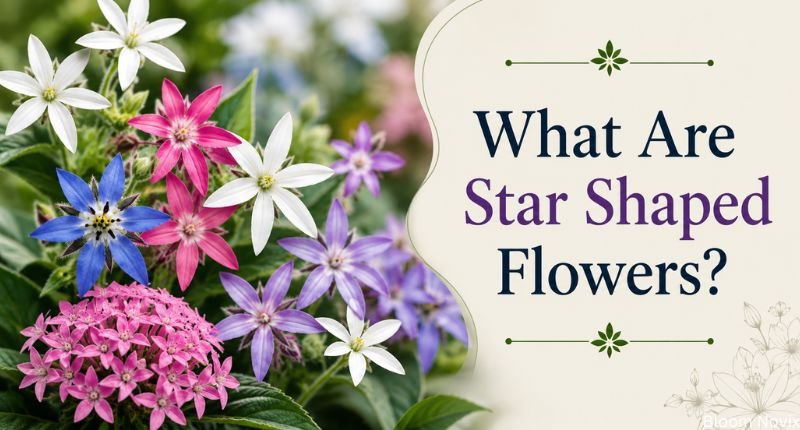
Star shaped flowers are blooms with petals that radiate outward from a central point. This creates a five- or six-pointed star outline. Some have sharp, narrow tips. Others have soft, rounded edges that still form a star-like shape.
You will find this petal pattern across many plant families. It is not limited to one type of flower. These blooms grow as vines, bulbs, shrubs, and even ground covers.
Here is a quick snapshot of the most popular options:
| Flower | Color | Petal Count | Growth Type |
| Star Jasmine | White | 5 | Climbing vine |
| Borage (Starflower) | Blue | 5 | Annual herb |
| Tweedia | Sky blue | 5 | Perennial |
| Star of Bethlehem | White | 6 | Bulb |
| Pentas | Pink, red, white | 5 | Perennial shrub |
Star Jasmine
Star Jasmine (Trachelospermum jasminoides) tops most lists for a reason. Its small white flowers release a sweet fragrance that fills entire gardens. Despite the name, this plant is not a true jasmine at all.
This vine climbs fast and covers fences, arbors, and walls with ease. The glossy dark leaves make the white star flowers pop even more.
- Blooms mostly in spring and early summer
- Thrives in full sun to partial shade
- Reaches heights of 15 to 20 feet when supported
- Works beautifully as a fragrant privacy screen
Star Jasmine needs sturdy support early on. Weak trellises can snap once the vine matures.
Star of Bethlehem Flower
The Star of Bethlehem (Ornithogalum) grows from a bulb and produces bright white blooms. Each flower has six pointed petals, often with a green stripe underneath.
This flower carries strong religious symbolism tied to its biblical name. Gardeners also love it for naturalizing large areas with minimal effort.
- Prefers cool, well-drained soil
- Flowers appear in early to mid-spring
- Spreads naturally to form dense clusters
- Can be mildly toxic to pets, so plant with care
That last safety point rarely appears in other articles, yet it matters greatly for pet owners.
Starflower (Borage)
Borage (Borago officinalis), commonly called Starflower, produces brilliant blue star-shaped petals. Bees absolutely love this plant, making it a pollinator magnet.
The flowers are also edible. Many chefs use them as a garnish or freeze them into ice cubes for drinks.
- Grows quickly from seed in one season
- Self-seeds easily, so it returns yearly
- Attracts bees, butterflies, and beneficial insects
- Leaves taste faintly like cucumber
Borage also improves nearby plants through companion planting, especially tomatoes and strawberries.
Pentas
Pentas produce clusters of tiny five-petaled flowers that create a starburst effect. They bloom in pink, red, white, and lavender shades.
Butterflies and hummingbirds flock to Pentas throughout the growing season. This makes them a favorite for pollinator gardens.
- Blooms continuously from summer through fall
- Handles heat and humidity well
- Grows well in garden beds or containers
- Needs minimal deadheading to keep flowering
Pentas rewards low-maintenance gardeners who still want nonstop color.
Tweedia
Tweedia (Oxypetalum caeruleum) offers a rare true sky-blue color rarely found in nature. Its soft, star-shaped blooms sit against silvery-green foliage.
Florists prize Tweedia for wedding bouquets and cut flower arrangements because the color photographs beautifully.
- Blooms shift from blue to purple-pink as they age
- Prefers full sun and warm conditions
- Works well in cottage-style gardens
- Popular choice for blue-themed floral designs
This color-shifting trait is a unique detail most competing articles skip entirely.
Isotoma
Isotoma produces delicate star-shaped flowers in blue, purple, pink, or white. The narrow, pointed lobes give each bloom a distinctly airy look.
This low-growing plant fills gaps beautifully in rock gardens and hanging baskets.
- Ideal for borders and container edges
- Prefers well-drained, sandy soil
- Sap can irritate skin, so wear gloves while handling
- Blooms nonstop from spring to first frost
That skin-irritation warning is important information many guides leave out completely.
Star Magnolia
Star Magnolia (Magnolia stellata) is a small flowering tree, not just a simple bloom. Its white, strap-like petals open wide to form a stunning star pattern each spring.
This tree blooms earlier than most magnolias, often before its leaves appear.
- Grows to 15-20 feet tall
- Extremely cold-hardy, surviving harsh winters
- Makes a striking focal point tree
- Fragrant blooms attract early pollinators
Most competitor lists mention this flower only in passing. It truly deserves its own spotlight.
Shooting Star Flower
The Shooting Star (Dodecatheon) has a wildly unique shape. Its petals sweep backward, resembling a star trailing across the sky.
This native woodland wildflower thrives in shaded, moist environments.
- Blooms in early spring
- Prefers partial to full shade
- Goes dormant in summer heat
- Perfect for native plant gardens
Its backward-swept petals make it one of the most visually unusual star-shaped blooms available.
Amsonia
Amsonia, also called Blue Star, produces clusters of soft blue star-shaped flowers in spring. Its willowy foliage turns golden yellow in fall, adding year-round interest.
- Extremely drought-tolerant once established
- Needs almost no maintenance
- Works well in perennial borders
- Fall foliage color is a hidden bonus feature
Few articles mention the stunning fall color transformation, yet it is one of Amsonia’s best traits.
Sedum
Certain Sedum varieties produce tiny yellow star-shaped flowers atop succulent foliage. These tough plants handle neglect better than almost any other flower on this list.
- Thrives in poor, rocky soil
- Requires very little water
- Ideal for rock gardens and green roofs
- Attracts bees and butterflies in late summer
Sedum proves that star-shaped flowers can survive even the harshest conditions.
Gentian
Gentian flowers produce deep blue or purple star-shaped blooms with a striking, almost electric color. Alpine gardeners especially treasure this plant.
- Prefers cool climates and acidic soil
- Blooms in late summer to fall
- Can be tricky to grow outside its ideal zone
- Colors rank among the deepest blues in nature
This flower rewards patient gardeners with one of the most vivid blues available.
Stapelia (Starfish Flower)
Stapelia, nicknamed the Starfish Flower, produces bizarre, fleshy star-shaped blooms. Some varieties even mimic a foul odor to attract flies for pollination.
- A succulent, needing minimal water
- Flowers can span several inches wide
- Popular among exotic plant collectors
- Not suitable for scent-sensitive spaces
This unusual entry rarely appears in standard flower guides, making it a true conversation starter.
Star-Shaped Flowers by Color
Color often guides the final choice for gardeners. Below is a breakdown by shade to help you decide faster.
White Star Shaped Flowers
Star Jasmine and Star of Bethlehem lead this category. Both bring clean, elegant tones perfect for moon gardens and evening landscapes.
Blue Star Shaped Flowers
Borage, Tweedia, Amsonia, and Gentian dominate the blue category. True blue blooms remain rare in nature, making these picks especially valuable.
Pink Star Shaped Flowers
Pink Pentas and Isotoma varieties bring a soft, romantic feel. They pair beautifully with cottage garden themes.
Purple Star Shaped Flowers
Purple Isotoma and certain Gentian varieties add a dramatic, mysterious tone to any landscape design.
Yellow Star Shaped Flowers
Sedum and Hypoxis produce cheerful yellow star blooms. They brighten rock gardens and sunny borders instantly.
Red, Cream & Greenish Star Shaped Flowers
Red Pentas bring bold energy to garden beds. Cream-toned Ornithogalum varieties and greenish-white blooms add subtle, understated elegance that many gardens lack.
Small Star Shaped Flowers
If you prefer delicate blooms over large showy ones, several options fit perfectly. Small star flowers work best when planted in groups or drifts.
- Isotoma
- Sedum
- Hypoxis
- Trientalis
- Gentian
Planting these in clusters creates a starry carpet effect across garden beds, far more impactful than a single scattered bloom.
Star-Shaped Flower Names Starting With Each Letter (A–Z Highlights)
Searching for a specific starting letter? Here are notable star-shaped flower names across the alphabet:
- A – Amsonia
- B – Borage
- G – Gentian
- H – Hypoxis
- I – Isotoma
- O – Ornithogalum
- P – Pentas
- S – Stapelia, Sedum, Starflower
- T – Tweedia, Trientalis
This alphabetical view helps gardeners quickly locate a flower by name recall alone.
Star Shaped Flower Names With 5 Letters
If you need a five-letter star-shaped flower name, these options fit perfectly:
- Pinks (Dianthus family, star-like form)
- Aster (technically composite, but often searched under this shape)
- Ixora (produces tight star-shaped clusters)
These shorter names are especially useful for crossword puzzles and word games.
Star Shaped Flowers for Gardens
Certain star-shaped flowers perform exceptionally well in full landscape settings. Choose based on your climate and available space.
- Star Jasmine for walls, fences, and trellises
- Borage for pollinator-friendly vegetable gardens
- Amsonia for low-maintenance perennial borders
- Sedum for dry, rocky landscape edges
- Tweedia for cottage-style flower beds
Always check your USDA hardiness zone before committing to a permanent garden plant.
Star Shaped Flowers for Containers
Limited space does not mean limited options. Several star-shaped flowers thrive happily in pots and planters.
- Pentas
- Isotoma
- Tweedia
- Compact Sedum varieties
Use containers with strong drainage holes and a well-draining potting mix. Place pots where each plant receives its ideal amount of sunlight daily.
Star Shaped Flowers That Attract Pollinators
Many star-shaped blooms double as pollinator magnets. Borage and Pentas rank among the best choices for attracting bees and butterflies.
| Flower | Attracts | Bloom Season |
| Borage | Bees | Spring–Summer |
| Pentas | Butterflies, Hummingbirds | Summer–Fall |
| Amsonia | Bees, Butterflies | Spring |
| Sedum | Bees, Butterflies | Late Summer |
Combining several bloom seasons ensures pollinators have food sources all year long.
Star Shaped Flowers and Their Meanings
Star-shaped blooms often symbolize hope, guidance, and wonder because of their celestial appearance. Meanings can shift slightly across different cultures.
| Flower | Symbolic Meaning |
| Star Jasmine | Love and elegance |
| Star of Bethlehem | Hope and faith |
| Borage | Courage |
| Tweedia | Tranquility |
| Amsonia | Calm beauty |
These meanings make star-shaped flowers popular choices for sympathy arrangements, weddings, and thoughtful gifts.
Unusual & Exotic Star Shaped Flowers
Beyond common garden varieties, several exotic star-shaped flowers stand out for collectors seeking something different.
- Stapelia – fleshy, starfish-like blooms
- Star Magnolia – tree-form star flowers
- Shooting Star – backward-swept petals
- Gentian – rare deep-blue tones
These unusual picks add texture and surprise to any specialty plant collection.
Star-Shaped Flowers for Bouquets and Weddings
Florists frequently choose star-shaped blooms for their striking symmetry and photogenic appeal. Tweedia and Star Jasmine appear often in bridal bouquets.
- Tweedia adds a soft blue accent
- Star Jasmine brings fragrance and elegance
- Pentas offers bold pops of color
- Borage works well in rustic, wildflower-style arrangements
Ask your florist about seasonal availability, since some of these blooms only appear during specific months.
How to Grow Star Shaped Flowers
Growing conditions vary by species, but these core steps apply broadly across most star-shaped flowers.
1. Choose the Right Flower
Consider your hardiness zone, available sunlight, and soil type before selecting a plant.
2. Provide Suitable Light
Most star-shaped flowers need several hours of direct sunlight daily. Woodland types like Shooting Star prefer shade instead.
3. Prepare Well-Drained Soil
Soggy soil harms most flowering plants. Improve drainage with compost or sand if needed.
4. Water According to the Plant
Succulents like Sedum need far less water than moisture-loving Borage. Always research individual needs.
5. Feed When Appropriate
Light fertilizing during active growth helps blooms flourish. Avoid overfeeding plants that prefer poor soil.
6. Remove Spent Flowers
Deadheading encourages continuous blooming in plants like Pentas and Isotoma.
7. Watch for Pests
Check regularly for aphids, spider mites, and caterpillars before infestations spread.
8. Give Vining Plants Support
Star Jasmine and similar vines need sturdy trellises or fences early in their growth.
Here is a quick reference table for the most popular choices:
| Flower | Light Needs | Water Needs | Hardiness Zone |
| Star Jasmine | Full sun–partial shade | Moderate | 8-10 |
| Borage | Full sun | Moderate | 2-11 (annual) |
| Tweedia | Full sun | Moderate | 9-11 |
| Sedum | Full sun | Low | 3-9 |
| Amsonia | Full sun–partial shade | Low | 3-9 |
FAQs About Star Shaped Flowers
What flower is star-shaped?
Star Jasmine, Borage, and Tweedia are classic examples. Each produces petals that spread into a clear star pattern.
What is a flower in the shape of a star called?
It is generally called a star-shaped flower or starflower. Some species even use “star” directly in their common name.
What are some flowers that look like stars?
Popular choices include Pentas, Isotoma, Star Magnolia, and Amsonia. All display the signature pointed-petal pattern.
What is the most popular star-shaped flower?
Star Jasmine is widely considered the most popular. Its fragrance and easy vine growth make it a garden favorite.
What flower looks like a five-pointed star?
Borage, Tweedia, and Pentas all show a clear five-pointed petal arrangement. This shape is common across the star-flower family.
What flowers are associated with the stars?
Star of Bethlehem, Shooting Star, and Star Magnolia all carry celestial names. Their shapes directly inspired these titles.
What are white star-shaped flowers?
Star Jasmine and Star of Bethlehem are the top white options. Both bring a clean, bright appearance to gardens.
What are blue star-shaped flowers?
Borage, Tweedia, and Amsonia offer stunning blue tones. True blue blooms remain rare, making these extra special.
What is a flower called Starflower?
Borage is most commonly known as Starflower. Its bright blue blooms and edible petals make it a standout choice.
What is the Star of Bethlehem flower?
It is a bulb plant in the Ornithogalum genus. The flowers show six white petals with a green underside stripe.
Are star-shaped flowers good for pollinators?
Yes, many varieties actively attract bees and butterflies. Borage and Pentas rank among the very best pollinator plants.
What do star-shaped flowers symbolize?
They often represent hope, guidance, and wonder. Their celestial shape naturally inspires these uplifting meanings.
Conclusion
Star shaped flowers bring a rare geometric beauty that few other blooms can match. From fragrant Star Jasmine to the unusual Stapelia, these plants suit nearly every garden style and skill level.
Before you choose your favorite, think beyond looks alone. Match the flower to your climate, sunlight, and soil for the best results. With the right pick, your garden will feel like a piece of the night sky brought down to earth.
BloomNovix is managed by an experienced team of content writers and SEO specialists with 4+ years of expertise in gardening and plant care. We provide well-researched guides, gardening tips, and insights on floral meanings to help plant lovers grow their indoor and outdoor gardens with confidence.

5 thoughts on “Star Shaped Flowers: 20+ Beautiful Blooms, Colors, Meanings & Growing Tips”