
Ever seen a dusty roadside sky blue flower? Looks fragile, but grows in hard soil and strong sunlight. Chicory is that tough little flower. The chicory flower meaning is far more than its beautiful petals; it’s been read for centuries for hope, patience, and loyalty.
The flowers open in the morning and close in the afternoon. The plant just produces new flowers the following day. This book reveals the message of love, endurance and quiet strength in that daily routine.
What Does the Chicory Flower Mean? (Quick Answer)
The chicory flower mainly means perseverance, patient waiting, and devotion. It also stands for hope, faith, and quiet independence. Most of these meanings come from how the plant behaves in the wild.
Chicory grows in tough places, such as roadsides, fields, and gravel edges. It does not wait for perfect soil. This habit made people see it as a symbol of resilience and strength.
Here are the core meanings at a glance:
- Perseverance: it thrives where other plants fail.
- Patient waiting: its blooms open daily and wait for the sun.
- Devotion: it stays loyal to the same roadside spot.
- Hope: its blue color feels calm and uplifting.
Origin of the Name Chicory
Chicory’s scientific name is Cichorium intybus. The French word chicorée is the origin of the English word. The French word is derived from Latin cichorium, which is of Greek origin. Others believe that its origins are even older, dating back to the ancient Egyptian language.
Chicory is known by a multitude of names. It is known as blue sailors, succory, coffeeweed, and blue dandelion. The names suggest the uses and perceptions of the plant. It is known as “blue sailors” for its bright blue flowers that grow along roads and fields.
The most romantic name is given to German folk speech. Germans refer to it as Wegwarte, meaning “the one who waits by the road. That name is directly connected to the legend of the waiting maiden. You’ll meet her later on in this guide.
Chicory Flower Meaning in Victorian Flower Language
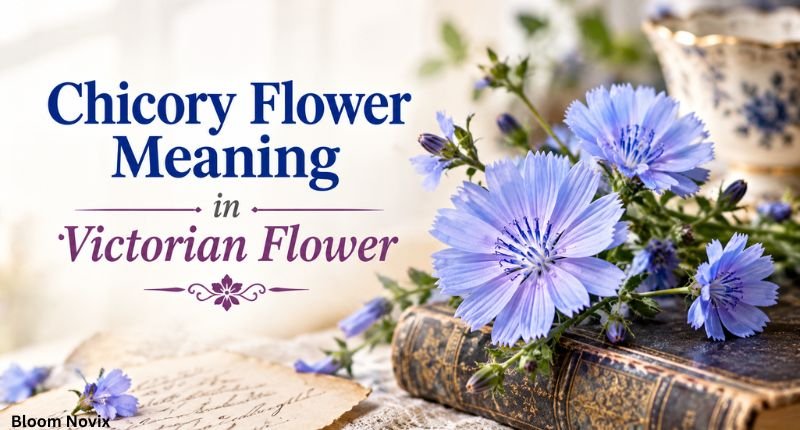
Floriography, the language of flowers, was a favourite pastime of the Victorians. Bouquets were used to convey a message that could not be spoken. Each flower was assigned a significance and chicory was included in the lists.
In many Victorian flower dictionaries chicory was associated with frugality. The plant is a good match for that meaning. It grows wild, requires little care and nourishes the human and animal population. Others associated it with the simplicity of life and modest happiness.
A more modern interpretation is sometimes found today. Now the same plant is a symbol of the patient love and loyal service. Both readings exhibit the change of flower meanings over time. They don’t cancel each other out, so you can use either one that best suits your message.
Chicory Flower Symbolism: Perseverance, Patient Waiting & Devotion
The chicory symbol is perseverance. The plant has a deep taproot that extends deep into the soil. This root is very beneficial in helping it withstand drought, mowing and poor soil. This is considered a measure of resilience and independence.
Then comes the waiting of patients. The flowers only last one day but the plant continues to flower throughout the season. It is never in a hurry and never gives up. This rhythm is a lesson that good things come to those who persist in coming.
Devotion makes up the trio. Chicory will grow in the same location each year. This faithful custom became a symbol of faithful love and longing. Some also associate it with unrequited love as the flower appears to wait for someone who never comes.
Chicory Flower Spiritual Meaning
Chicory symbolizes faith, perseverance and self-development in a spiritual sense. It has a deep root, indicating its close relationship with the ground. Its blue sky petals are outstretched toward the light. Together they imply a soul which remains on earth and yet gazes upwards.
Spiritual Symbolism: Blue flowers are often associated with calm, truth, and peace. Chicory teaches about patience. It conveys the message of reblooming after each closing. This is interpreted as a call to renewal and change by many.
A few also look for the significance of chicory in their dreams. If you dream of chicory, it could mean that you are waiting, hoping, or that you have a long time desire. Don’t take this as a rule, take it as a reflection. The meaning of dream symbols always relates to your life and emotions.
Chicory Flower Meaning by Color: Blue, White & Pink
Blue is the classic chicory color, and it carries the main meanings. White and pink chicory appear less often. They add softer shades of meaning. Remember that color meanings come mostly from modern flower lore, not from ancient texts.
Blue chicory stands for patience, loyalty, and hope. White chicory suggests new beginnings and gentle purity. Pink chicory points to tenderness and quiet affection. Use the table below to compare them quickly.
| Color | Main Meaning | Best Message |
| Blue | Patience, loyalty, hope | “I will wait for you.” |
| White | Purity, fresh starts | “A new chapter begins.” |
| Pink | Tenderness, soft love | “I care about you deeply.” |
Chicory Plant Profile: Appearance, Bloom Time & Habitat
Chicory is a perennial flowering plant in the daisy family (Asteraceae). It grows tall, thin, and branching stems. The flowers sit close to the stem, with sky-blue petals that have square, fringed tips. Each bloom looks like a small, tidy star.
The plant blooms from early summer to early fall. Each flower opens in the morning and closes by afternoon. On cloudy or hot days, it may close sooner. This is why timing matters if you want to see or photograph it.
Chicory is native to Europe, but it now grows in many parts of the world. You will often see it along roadsides, in meadows, and near fields. Here is a quick profile:
| Feature | Details |
| Scientific name | Cichorium intybus |
| Family | Asteraceae (daisy family) |
| Height | About 1 to 5 feet |
| Bloom time | Summer to early fall |
| Flower color | Mostly blue; rarely white or pink |
| Habitat | Roadsides, meadows, open fields |
History of Chicory: From Ancient Egypt to Today
Chicory has a long human history. Ancient Egyptians are widely believed to have used it as food and medicine. Romans ate the leaves as greens. The poet Horace even mentioned chicory as part of his simple diet.
In Europe, people grew chicory for its roots and leaves. In the early 1800s, coffee shortages pushed people in France to roast chicory root as a substitute. The habit spread across Europe. Later, it became popular in places like New Orleans, where chicory coffee still holds a proud place.
Today, chicory has three lives. Farmers grow it as animal forage. Food makers use its root for inulin, a natural fiber. Wildflower lovers enjoy it as a roadside beauty. Few plants have stayed useful for so long.
Chicory in Folklore, Traditions & Literature
The most famous of the legends is from European folk tales. A young woman waited by the roadside for her lover, who never came back. She waited so long that she turned into a blue chicory flower. The following is a story about the German nickname Wegwarte, “the one who waits by the road.
The legend influenced people’s interpretation of the flower. It became a symbol of unrequited love, loyalty and longing. Chicory was also endowed with a magical reputation by folk traditions. Some tales claim that it can unveil secrets or safeguard travellers.
Chicory was also a symbol for patience in love for writers and poets. It was assigned a role in Victorian flower books. Since then, numerous writers have stolen its roadside solitariness. One blue flower along a path is just the right setting for a sad love story.
Chicory Flower Tattoo Meaning
A chicory tattoo has a subtle and profound message. Most people select it to demonstrate resilience, hope and personal development. It’s for anyone who has been through challenging times and persevered. The design is soft yet firm, similar to the plant.
There are lots of reasons why people get chicory tattoos. Some select it for the sake of long-distance love or loyalty. Some people use it as a reminder of the patience towards life. Its roots are also on the roadside, which is appealing to those who appreciate freedom and independence.
Here are some popular design ideas:
- A single blue bloom on the wrist or ankle.
- A branching stem with several flowers along the arm or ribs.
- Chicory with other wildflowers for a meadow-style piece.
- A watercolor style to highlight the sky-blue petals.
Chicory Uses: Culinary, Coffee Substitute & Medicinal
In the kitchen, chicory offers many options. People eat the young leaves raw in salads or cook them as greens. They also roast the root and grind it into a coffee-like drink. The taste is deep, earthy, and slightly bitter.
Chicory root is rich in inulin, a type of prebiotic fiber. Food makers add it to bars, drinks, and supplements. Traditional herbal medicine used chicory for digestion and liver support. Modern research on these claims is still limited, so treat them as traditional uses, not cures.
Here are the common uses:
- Salads and cooked greens from young leaves.
- Chicory coffee from roasted root.
- Fiber ingredient for processed foods.
- Animal forage for livestock.
- Herbal teas in traditional practice.
Is Chicory Safe? Edibility, Side Effects & Pet Toxicity
For most people, chicory is safe to eat in normal food amounts. Excessive root fiber may lead to gas, bloating or diarrhea. If you’re new to it, go with small amounts. Chicory root products should be used with caution in pregnant women, so consult a doctor first.
Chicory is a member of the daisy family. Ragweed can cause reactions in people who are allergic to ragweed or related plants. Look for signs of itching, rash or mouth irritation. If it causes any symptom, discontinue use and consult a physician if symptoms worsen.
Chicory is not thought to be dangerous for pets, and is even eaten by livestock. However, a big quantity can cause stomach upset in dogs and cats. Do not allow pets to eat plants growing on roadsides. There could be sprays, fumes or other hazards in those areas. Call your vet if your pet shows any signs of illness.
Chicory vs. Look-Alike Flowers: How to Tell Them Apart
Several blue or purple flowers can look like chicory at first glance. The most common mix-up is with cornflower. Others include wild lettuce, asters, and dandelion relatives. A careful look at the petals, stems, and leaves solves the puzzle.
Look at the flower first. Chicory has sky-blue petals with square, toothed tips. Its blooms sit tightly along a stiff, branching stem. Its leaves are sparse, and the lower ones look like dandelion leaves. Check the table below for quick comparisons.
| Feature | Chicory | Cornflower |
| Petal shape | Square, toothed tips | Fringed, thistle-like |
| Flower center | Flat, daisy-style | Rounded, bushy |
| Stem | Stiff, branching | Slender, wiry |
| Leaves | Dandelion-like at base | Narrow, grayish |
| Bloom habit | Closes by afternoon | Stays open longer |
Chicory Flower Gifting Guide: When & Whom to Give
Chicory makes a thoughtful, unusual gift. It says, “I am here, and I will wait.” That message suits people who value loyalty and patience. A blue chicory bouquet feels personal because most people never expect it.
Here are the best occasions to give chicory:
- Long-distance relationships to show steady love.
- Anniversaries to celebrate lasting devotion.
- Encouragement gifts for someone facing a tough time.
- Graduations to honor hard work and perseverance.
- Friendship gifts to show quiet loyalty.
Keep in mind that chicory blooms are short-lived once cut. Give them fresh and on the same day when possible. Pair them with sturdier flowers to extend the bouquet’s life. Add a small card that explains the meaning, because the message makes the gift special.
Chicory in Weddings, Bouquets & Floral Design
Chicory fits rustic, garden, and wildflower weddings beautifully. Its sky-blue color adds the classic “something blue” touch. The airy stems give bouquets a loose, natural shape. Couples also love its meaning of faithful, patient love.
Florists use chicory in bouquets, boutonnieres, and table centerpieces. It pairs well with white daisies, baby’s breath, lavender, and soft greenery. Blue chicory also looks lovely beside yellow wildflowers. The contrast makes the blue stand out.
Cut chicory lasts only a short time, so planning matters. Buy or cut the stems close to the event day. Keep them in cool water and out of direct heat. Many florists use chicory as a delicate accent, not as the main flower, for this reason.
How to Grow and Care for Chicory
Chicory is an easy-to-grow plant. Likes full sun and well-drained soil. Tolerant of poor and rocky soils and short dry periods. It is very deep rooted and will do most of the work for you, so you don’t need to worry about it much.
Seed sowing in spring or early summer. Sprinkle them on top of the soil, and lightly cover them. Water lightly until the seedlings are established. After that, water only during long dry periods. The majority of plants flower during their first or second growing season.
Chicory is easily spread and is considered a weed or invader in some areas. If you wish to control seed setting, cut out the spent flowers before they set seed. Please refer to local rules before planting in open land. It is contained and neat in a pot or in a garden border.
Chicory Flower Fun Facts, Myths vs. Reality & Florist Tips
Chicory has plenty of surprises. Each bloom lasts just one day, and the plant makes new ones daily. Its root once replaced coffee in wartime Europe. It belongs to the same family as daisies and sunflowers. Here are quick fun facts:
- Chicory flowers close on hot afternoons.
- Its taproot can reach deep underground.
- Its leaves look like dandelion leaves.
- People have eaten it for thousands of years.
- Cattle and sheep graze on it happily.
Now for myths. Myth: chicory is just a weed. Reality: it is a food plant, a forage crop, and a symbol with deep roots. Myth: its coffee contains caffeine. Reality: chicory root contains none. Myth: it works as a miracle cure. Reality: research is limited, so treat it as a traditional remedy only.
Florists also share smart tips. Cut stems early in the morning, when blooms are open. Place them in cool water right away. Use chicory as an accent, because the flowers close quickly and look best fresh.
FAQs
1. What is the spiritual meaning of chicory?
It means faith, patience, and endurance. Its deep root and upward-reaching blooms show a grounded soul that still seeks light.
2. What is the best occasion for chicory?
Anniversaries, long-distance love, and encouragement gifts suit it best. It also works well for rustic weddings.
3. What does blue chicory mean?
Blue chicory means patience, loyalty, and hope. It is the classic and most common symbolic color.
4. What does white chicory mean?
White chicory means new beginnings and gentle purity. It is rare, so it feels extra special.
5. What does pink chicory mean?
Pink chicory means tenderness and soft affection. It suits quiet, caring messages.
6. Is chicory toxic to pets?
Chicory is generally low risk for pets. Large amounts may upset the stomach, so call a vet if symptoms appear.
7. Can chicory be eaten?
Yes, you can eat the leaves, flowers, and roasted root. Start small, and avoid wild plants from polluted roadsides.
8. When does chicory bloom?
Chicory blooms from early summer to early fall. Each flower opens in the morning and closes by afternoon.
9. Is chicory invasive?
It can be. Chicory spreads fast in some regions, so check local rules and remove spent flowers before they seed.
10. Why is chicory called chicory?
The name comes from the French chicorée and the Latin cichorium. The deeper roots likely go back to Greek and possibly older languages.
11. What did chicory mean historically?
Victorians linked it to frugality, while folk tales tied it to waiting and loyal love. This shows how chicory flower meaning changed across time and culture.
Conclusion
The meaning of chicory flower is a combination of strength, patience and faithful love. This low-growing blue wildflower grows in areas where few other plants can grow. It will be open in the morning and hopes for more flowers to come. This is a very simple lesson in resilience and hope.
Chicory can now be read as a gift, tattoo, garden plant or spiritual sign. It dates back to the ancient Egyptians until today. It remains a folktale that will never cease to stir the emotions. The next time you see a blue flower along the roadside, take a closer look. You may just meet a quiet teacher.

BloomNovix is managed by an experienced team of content writers and SEO specialists with 4+ years of expertise in gardening and plant care. We provide well-researched guides, gardening tips, and insights on floral meanings to help plant lovers grow their indoor and outdoor gardens with confidence.





1 thought on “Chicory Flower Meaning: Symbolism, History & Spiritual Significance”