Have you ever seen a flower open at night and disappear before morning? The Queen of the Night is one of those rare blooms that feels almost magical. Its brief appearance has given it deep connections with love, mystery, patience, beauty, and transformation.
For generations, people have been fascinated by this unusual flower and the meaning behind its nighttime bloom. Some see it as a symbol of good luck, while others connect it with love, spirituality, and special moments that do not last forever. In this guide, we’ll explore the queen of the night flower meaning, its symbolism, folklore, connection to love, and even its meaning in tattoos.
What Is the Queen of the Night Flower?
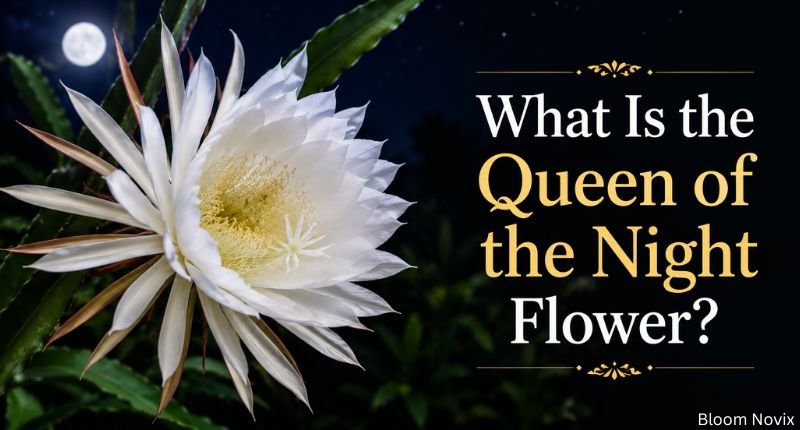
he Queen of the Night is a striking cactus known scientifically as Epiphyllum oxypetalum. It grows naturally in Central America, often climbing on other plants without harming them. You won’t find bold colors here. Instead, it produces large, white, funnel-shaped flowers with a strong, sweet fragrance. Unlike the American Rose Flower, which is often admired for its classic beauty and lasting presence, the Queen of the Night is known for its short-lived but unforgettable bloom.
What makes it unforgettable is its timing. The flower opens only after sunset and closes before sunrise. You get one night — that’s it. This rare habit is exactly why the plant carries such deep symbolic weight across cultures.
- Belongs to the Cactaceae family
- Grows as an epiphyte, not a parasite
- Produces flat, leaf-like green stems
- Blooms are large, white, and heavily scented
Why Is It Called the Queen of the Night?
You already sense the answer. It “rules” the night because nothing else competes with its beauty after dark. While most flowers show off during the day, this one waits patiently for darkness to arrive.
Its royal name isn’t just poetic branding. The flower’s scent grows stronger at night specifically to attract nocturnal pollinators like moths. So its “queenly” behavior actually has a scientific reason behind it — survival, not vanity.
What the Queen of the Night Flower Looks Like
Picture this: pale green stems that look almost ordinary during the day. Then, as the sun sets, a bud begins to swell. Within hours, it unfolds into a white, star-shaped bloom with a golden center and a fragrance that fills the whole room.
You’ll notice these features:
- Petals that curve outward like a trumpet
- A strong, jasmine-like scent
- A bloom width of 4 to 6 inches
- Stems with no visible leaves
By morning, the same flower wilts. That contrast — from spectacular to gone — is central to its symbolism.
Queen of the night flower name
You may hear this plant called by several different names, depending on where you live. Some names focus on its royal appearance. Others focus on its nighttime habit.
- Queen of the Night
- Dutchman’s Pipe Cactus
- Princess of the Night
- Night-Blooming Cereus (though this term also applies to other species)
- Epiphyllum oxypetalum (its scientific name)
Knowing these names helps you recognize the plant in different regions and avoid confusing it with unrelated cacti that share similar nicknames.
Queen of the Night Flower Meaning
So, what does this flower actually represent? At its core, the queen of the night flower meaning centers on rare beauty, mystery, patience, and the value of fleeting moments. It reminds you that something doesn’t need to last forever to matter.
Here’s a simple breakdown of its core symbolism:
| Symbol | What It Represents |
| Mystery | Hidden emotions and the unknown |
| Rare Beauty | Something precious because it’s uncommon |
| Patience | Trusting the right timing in life |
| Transformation | Quiet growth before a big change |
| Fleeting Moments | Appreciating what won’t last |
You don’t need to be spiritual to feel this symbolism. Anyone who has experienced a short but powerful moment in life — a conversation, a sunset, a goodbye — can relate to what this flower represents.
Queen of the Night Flower Meaning in Love
If someone gives you this flower, pay attention. In the language of flowers, it often symbolizes secret love and deep, private affection. Because it blooms in darkness, it’s linked to feelings that aren’t shown openly — love that grows quietly before it’s revealed.
You can think of it as a symbol of:
- A rare or unexpected connection
- Feelings kept close to the heart
- Deep emotional loyalty
- A relationship that deserves more attention
- Love that isn’t loud, but is real
This flower also works as a gentle reminder. Relationships, like this bloom, need appreciation now — not later. Don’t wait for the “right time” to tell someone how you feel.
Queen of the Night Flower Meaning Spiritual
On a spiritual level, this flower represents something deeper than romance. It’s tied to inner awakening and self-discovery. Many people see it as proof that beauty and clarity can appear even during your darkest, quietest periods.
Religious and Spiritual Interpretations
Different faiths and belief systems read this flower in slightly different ways, but a few themes repeat again and again.
- In many spiritual traditions, the flower symbolizes enlightenment that arrives suddenly, after long periods of stillness.
- Buddhist-influenced interpretations sometimes link it to impermanence — the idea that nothing lasts, and that’s okay.
- Some spiritual practitioners use its bloom as a meditation symbol, reminding you to stay present.
- It’s also connected to intuition, since night is traditionally linked to dreams and inner reflection.
None of these interpretations are scientific facts. They’re beliefs passed down through culture and personal experience — and that’s exactly what gives them meaning.
Queen of the night flower myth
Every culture that has encountered this flower has told a story about it. One popular myth suggests that the flower only blooms for someone who truly needs a sign of hope. Another version claims that catching its bloom brings a wish come true, similar to a shooting star.
While these stories aren’t historically documented facts, they’ve spread because the flower’s real behavior — sudden, beautiful, and brief — naturally invites legend. Myths grow around things we can’t fully explain, and this flower fits that pattern perfectly.
Why Does the Queen of the Night Bloom at Night?
This isn’t magic — it’s biology. The plant evolved to bloom at night because its main pollinators, moths, are active after dark. A white, highly fragrant flower is far easier for a moth to find in low light than a colorful one.
- Its pale petals reflect what little light is available
- Its strong scent travels farther in cool night air
- Daytime heat would cause the delicate bloom to wilt faster
- Nighttime blooming reduces competition with day-flowering plants
So while the symbolism feels poetic, the real reason is survival — a smart evolutionary strategy disguised as beauty.
Queen of the night flower blooming time
Timing matters if you want to witness this event yourself. The flower typically opens between 9 PM and midnight, depending on temperature and humidity. It reaches full bloom for just a few hours before beginning to wilt by early morning.
- Blooming season: usually summer to early autumn
- Bloom duration: one single night
- Best viewing window: 10 PM to 2 AM
- Frequency: some mature plants bloom multiple times per season
If you’re growing one, keep an eye on the buds in the evening — once they start swelling, the show usually begins within hours.
Explore More: Ugly Flower Names
Historical Roots and Botanical Identity
The plant’s botanical identity was formally recognized by scientists studying Central American flora. Today, the Royal Botanic Gardens, Kew officially lists Epiphyllum oxypetalum as an accepted species. This gives the plant real scientific credibility behind all its folklore.
Historically, it traveled from its native regions to gardens across Asia, particularly through trade and colonial-era plant collecting. That journey is part of why its symbolism looks so different depending on where you are in the world.
Queen of the Night Flower in Culture and Folklore
Across the globe, this flower has picked up meanings far beyond botany. People don’t just see a cactus — they see a message.
- In some traditions, it represents good fortune arriving unexpectedly.
- Others treat it as a symbol of new beginnings, since it “starts fresh” every bloom.
- It’s often linked to secret wishes, especially among young lovers.
- In household folklore, spotting a bloom is sometimes treated as a sign to pay attention to your intuition.
There is no single “correct” folklore. The meaning shifts depending on family tradition, region, and personal belief.
Cultural Meanings in Asia
In several parts of Asia, this flower holds a particularly strong cultural presence. In Chinese culture, it’s sometimes called “Tan Hua”, and its brief bloom is associated with the phrase “a flash in the pan” — representing something magnificent but short-lived, much like fame or a fleeting opportunity.
- In China, it symbolizes fleeting glory and rare success.
- In parts of Southeast Asia, it’s grown near homes for good luck.
- In India, some households treat a nighttime bloom as a spiritually significant event worth staying up for.
- Its rarity has made it a popular subject in Asian poetry and art for generations.
Queen of the Night Symbolism in American Gardens
In the United States, the symbolism shifts slightly toward personal growth and mindfulness. American gardeners often grow this plant specifically for the experience of waiting — treating the bloom night like a small event with friends or family.
- Often associated with patience and mindfulness
- Popular in “bloom-watch parties” among plant enthusiasts
- Seen as a symbol of rare personal achievements
- Valued for teaching gardeners to slow down and observe nature
This shows how the same flower can carry different emotional weight depending on the culture observing it.
The Meaning of White Petals and Night Blooming
Color matters in flower symbolism, and white is never random. White petals traditionally represent purity, clarity, and new beginnings. Combine that with a nighttime bloom, and you get a flower that symbolizes clarity found in darkness — a comforting idea for anyone going through a hard time.
- White = purity, honesty, simplicity
- Night blooming = hidden strength, quiet resilience
- Together = clarity that emerges even in difficult moments
This combination is part of why the flower resonates so strongly with people going through personal change.
Transformation: From Quiet Plant to Spectacular Bloom
For most of the year, this plant looks unremarkable — just green, flat stems with no obvious beauty. Then, seemingly out of nowhere, it produces one of the most dramatic blooms in the plant world.
This journey mirrors real personal growth. You often can’t see change happening while it’s in progress. Growth is quiet, slow, and easy to overlook — until suddenly, the results show up all at once.
Symbolism in Tattoos and Personal Style
This flower has become a popular tattoo choice, and the reason isn’t just visual. People choose it to represent personal transformation, resilience, or a private chapter of their life they don’t explain to everyone.
- Common placement: forearm, shoulder, or back
- Popular meaning: inner strength shown quietly
- Often paired with moon or star imagery
- Chosen by people who’ve been through major life changes
If you’re considering this tattoo, know that it carries a story — one of patience, not just beauty.
Jewelry, Decor, and Fashion Meaning
Beyond tattoos, this flower shows up in jewelry and home decor for similar reasons. A pendant shaped like this bloom often symbolizes quiet confidence — beauty that doesn’t need constant attention to be valuable.
- Necklaces: symbolize private strength
- Home decor prints: represent calm and mystery
- Fashion motifs: linked to elegance that isn’t “loud”
- Gifted jewelry: often given to mark personal milestones
Choosing this flower in style choices sends a subtle message: you don’t need to be seen all the time to be extraordinary.
Emotional and Psychological Meaning
Psychologically, this flower connects to themes of self-worth and emotional patience. Its short bloom teaches an important lesson: your best moments don’t need to be permanent to be meaningful.
- Encourages letting go instead of clinging to outcomes
- Represents emotional resilience during quiet struggles
- Reminds you that value isn’t measured by how long something lasts
- Supports the idea of living in the present moment
This is why therapists and mindfulness coaches sometimes reference this flower when discussing acceptance and impermanence.
Common Misunderstandings About the Flower
A few myths about this plant get repeated so often that people assume they’re true. Let’s clear them up.
- Myth: It only blooms once in its entire lifetime. Fact: Mature plants can bloom multiple times per year.
- Myth: It’s extremely rare and hard to find. Fact: The plant itself is common in cultivation; only the bloom timing feels rare.
- Myth: It’s the same as every “night-blooming cereus.” Fact: That name applies to several unrelated cacti.
- Myth: The flower is toxic to touch. Fact: It is not known to be harmful through normal contact.
Clearing up these misunderstandings helps you appreciate the plant for what it actually is, not just internet rumors.
Positive and Negative Symbolism
Like most powerful symbols, this flower carries both light and shadow meanings depending on context.
| Positive Symbolism | Negative Symbolism |
| Rare beauty and rebirth | Fear of missing a moment |
| Hope during darkness | Sadness over things ending |
| Deep, private love | Hidden or unspoken pain |
| Patience rewarded | Anxiety about impermanence |
| Spiritual awakening | Feeling overlooked or unseen |
Understanding both sides gives you a fuller, more honest picture — not every symbol has to be purely positive to be meaningful.
Is the Queen of the Night the Same as Night-Blooming Cereus?
This is one of the most common points of confusion, and it deserves a clear answer: no, not always. “Night-blooming cereus” is a general nickname used for several different cactus species, not one specific plant.
| Plant | Scientific Name | Native Region |
| Queen of the Night | Epiphyllum oxypetalum | Central America |
| Selenicereus grandiflorus | Selenicereus grandiflorus | Mexico, Caribbean |
| Moonflower Cactus | Various species | Southwestern USA |
If you want to be precise, always refer to the Queen of the Night Flower by its scientific name: Epiphyllum oxypetalum.
Queen of the night flower poisonous
Here’s some good news if you have pets or kids around your garden: this plant is not considered toxic to humans in typical contact situations. There’s no strong documented evidence of poisoning from touching or being near the flower.
- Not listed as a major toxic hazard by common plant safety databases
- Ingesting large amounts of any unfamiliar plant is still not recommended
- Always keep new plants away from small children and curious pets as a general precaution
- If you’re unsure, consult a local poison control resource for your specific plant variety
Queen of the Night flower price
Wondering what it costs to bring one home? Prices vary depending on size, maturity, and where you’re buying from.
- Small cuttings: roughly $8 to $20
- Established young plants: roughly $20 to $50
- Mature, bloom-ready plants: $50 and above
- Rare or larger specimens: prices can climb significantly at specialty nurseries
Buying a cutting flower arrangement is usually the most affordable way to start, though you’ll need patience — it can take a couple of years before your plant produces its first bloom.
Is the Queen of the Night Flower Good for Gifting?
Absolutely — and it makes a genuinely memorable gift. Its story alone makes it more meaningful than a typical bouquet, because you’re giving someone an experience, not just a plant.
Consider gifting it to someone who is:
- Starting a new chapter in life
- Going through personal transformation
- Someone you care about deeply but rarely say it to
- A plant lover who appreciates something unusual
A simple card message works well here: “May you always find beauty, even in the quietest moments.”
FAQs
What does the Queen of the Night flower symbolize?
It symbolizes mystery, rare beauty, and fleeting moments. The queen of the night flower meaning centers on appreciating beauty that doesn’t last forever.
Is the Queen of the Night flower a symbol of love?
Yes. It often represents secret or deeply private love that isn’t shown openly to everyone.
What does a Queen of the Night tattoo mean?
It typically represents quiet inner strength and personal transformation over time.
Is the Queen of the Night flower a religious symbol?
It’s not tied to one specific religion, but many spiritual traditions link it to awakening and impermanence.
Does the Queen of the Night symbolize death?
Not directly. It more often represents endings as part of natural change, not death itself.
Why is it associated with mystery?
Because it blooms only at night, hidden from most people who never get to witness it.
Is the Queen of the Night flower actually rare?
The plant is common, but a full bloom night still feels rare because it happens so briefly.
What is the queen of the night flower meaning spiritual?
Spiritually, it represents inner awakening, intuition, and finding clarity during dark or uncertain times.
Why is it called Queen of the Night?
Because its large, fragrant flowers open only after sunset, ruling the nighttime hours.
Is Queen of the Night a real flower?
Yes. It’s a real cactus species, scientifically known as Epiphyllum oxypetalum.
Does Queen of the Night flower mean good luck?
In some cultures, yes — a bloom is seen as a sign of good fortune or a wish coming true.
What is another name for Queen of the Night?
It’s also called Dutchman’s Pipe Cactus, Princess of the Night, and Night-Blooming Cereus.
What is the story behind the Queen of the Night flower?
Its story comes from its rare, one-night bloom, which inspired myths of luck, love, and hope across cultures.
What does Queen of the Night flower mean?
It means rare beauty, quiet transformation, and the importance of valuing short but powerful moments.
Conclusion
At its heart, the queen of the night flower meaning is about appreciating beauty, even when it doesn’t last long. The flower blooms for just one night, but that short moment can leave a lasting impression.
Whether you see it as a symbol of secret love, spiritual awakening, or personal transformation, its message is simple: some moments are special because they don’t last forever. Sometimes, all it takes is one beautiful night to create a memory that stays with you.

BloomNovix is managed by an experienced team of content writers and SEO specialists with 4+ years of expertise in gardening and plant care. We provide well-researched guides, gardening tips, and insights on floral meanings to help plant lovers grow their indoor and outdoor gardens with confidence.