Have you ever wondered why a simple red flower carries so much weight in Ohio’s history? The Ohio state flower meaning goes far beyond its bright petals and sweet fragrance — it tells the story of a beloved president, a tragic assassination, and a state’s lasting act of remembrance. Every scarlet carnation you see today carries a piece of that legacy.
This flower isn’t just a pretty symbol chosen at random. It represents love, respect, and devotion, tied directly to one of Ohio’s most famous sons. By the end of this article, you’ll understand exactly why this flower was chosen, what it symbolizes, and how it still shapes Ohio’s identity today.
What Is Ohio’s State Flower Meaning?
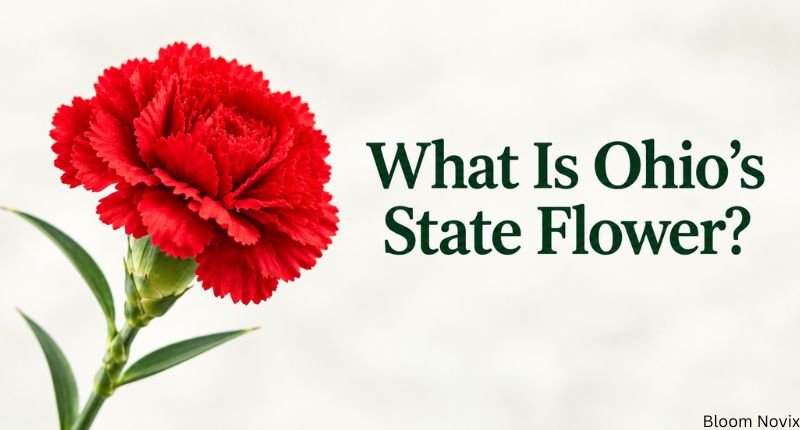
Ohio’s official state flower is the scarlet carnation, scientifically known as Dianthus caryophyllus. It belongs to the Caryophyllaceae family and stands out for its ruffled petals, deep red color, and spicy clove-like scent. Carnations have long been connected with love, admiration, and affection, adding another layer of meaning to this striking flower. Similar ideas of love and affection can be found in the symbolism of clover in love.
Here’s a quick snapshot of the basics:
| Detail | Information |
| Official Name | Scarlet Carnation |
| Botanical Name | Dianthus caryophyllus |
| Family | Caryophyllaceae |
| Adopted | February 3, 1904 |
| Color | Deep red / scarlet |
| Symbolism | Love, respect, remembrance |
The flower wasn’t chosen for its rarity or native roots. Instead, it earned its place through a powerful human story — one connected to loyalty, friendship, and loss. That’s what makes the Ohio state flower meaning so unique compared to other states.
- It’s a cultivated flower, not a wildflower
- It was Ohio’s first official floral emblem
- The choice reflects sentiment, not botany
Scarlet Carnation Meaning and Symbolism
At its core, the scarlet carnation represents love, admiration, and devotion. Its deep red color naturally draws associations with passion and strength, which is why so many cultures use it in tributes and celebrations.
In Ohio specifically, the flower carries added layers of meaning tied to public service and sacrifice. It’s not just about romantic love — it’s about respect for leadership and remembrance of someone the state deeply valued.
- Red color symbolizes love, courage, and admiration
- Ruffled petals represent resilience and strength
- Lasting bloom reflects the flower’s association with permanence and memory
- Often linked to patriotism because of its presidential ties
Unlike flowers chosen purely for beauty, this one carries emotional and historical significance woven into every petal.
History Behind Ohio’s State Flower
The history of the Ohio state flower stretches back to the 1870s, decades before it became official. It began not in a government building, but on a small-town political stage in Alliance, Ohio.
Before it symbolized a president, the scarlet carnation was simply a hobbyist’s favorite bloom, propagated locally by a passionate horticulturist. That personal connection eventually grew into something much bigger than one man’s garden.
- The flower’s roots trace back to Alliance, Ohio in 1866
- It started as a horticultural passion project, not a political symbol
- Its rise to state flower status took nearly 40 years
- The story blends friendship, politics, and tragedy
This slow evolution from garden flower to state emblem is part of what makes its meaning so rich and layered.
The William McKinley Connection
No discussion of the Ohio state flower meaning is complete without William McKinley, the 25th President of the United States and a native Ohioan. McKinley was rarely seen without a scarlet carnation pinned to his lapel.
He wore the flower during speeches, debates, and public appearances throughout his political career. Over time, the carnation became so closely tied to his image that people instantly associated the two.
- McKinley served as both Ohio’s governor and U.S. president
- He wore the carnation as a personal trademark
- His staff made sure fresh carnations were always available
- The flower became a recognizable part of his public identity
This personal habit is what eventually transformed a simple garden flower into a powerful state symbol.
Dr. Levi Lamborn and the Origin Story
The story behind the flower actually starts with Dr. Levi Lamborn, an Alliance physician and amateur horticulturist who first propagated the scarlet carnation from French seedlings.
In 1876, Lamborn ran against a young William McKinley for a seat in Congress. Despite being political rivals, the two shared a genuine friendship. Before each debate, Lamborn gave McKinley a carnation boutonniere as a gesture of goodwill.
- Lamborn grew the flower in his own greenhouse in Alliance, Ohio
- He and McKinley were political opponents but personal friends
- McKinley wore Lamborn’s carnation during every debate
- McKinley won that 1876 election, and the flower’s legend began
This small gesture between rivals eventually shaped an entire state’s floral identity — a detail many articles overlook when explaining the flower’s origin.
When Was the Scarlet Carnation Adopted?
The scarlet carnation officially became Ohio’s floral emblem on February 3, 1904, when the Ohio General Assembly passed a joint resolution.
The resolution didn’t just name a flower — it made a direct statement about honoring McKinley’s memory. Part of the original text described the flower as “a token of love and reverence for the memory of William McKinley.”
- Adopted through a formal joint resolution
- Passed just three years after McKinley’s death
- Later codified into the Ohio Revised Code, Chapter 5, Section 5.02
- Remains unchanged since its original adoption
This makes Ohio’s floral emblem one of the most consistent and unaltered state symbols in the country, still standing exactly as it was written over a century ago.
Explore More: Cyclamen Flower Meaning
McKinley’s Assassination and the Flower’s Deeper Meaning
On September 14, 1901, President McKinley attended the Pan-American Exposition in Buffalo, New York. Just moments before he was shot by an assassin, he had removed the carnation from his lapel and handed it to a young girl in the crowd.
This heartbreaking detail added an emotional weight to the flower that no ordinary bloom could carry. What had once symbolized good luck suddenly became a symbol of loss and remembrance.
- McKinley gave away his carnation minutes before the shooting
- His death shocked the nation and deeply affected Ohio
- The flower shifted from a “lucky charm” to a memorial symbol
- Public sentiment directly influenced its official adoption in 1904
This tragic timing is a key reason the flower’s meaning feels so personal and emotional even today.
Spiritual Meaning of the Scarlet Carnation
Beyond its political history, the scarlet carnation also holds spiritual significance that many people connect with on a personal level. Carnations, in general, have long been viewed as symbols of pure love and unwavering loyalty.
In a spiritual sense, the scarlet variety specifically represents deep affection combined with strength during hardship — a fitting reflection of Ohio’s own story of loss and resilience.
- Represents enduring love that survives hardship
- Symbolizes strength during grief, tying back to McKinley’s death
- Seen by some as a flower of remembrance and honor
- Associated with loyalty, echoing Lamborn and McKinley’s friendship
This spiritual layer gives the flower emotional depth that goes beyond politics or botany.
Color Meaning — Why Red/Scarlet?
Color plays a huge role in how we interpret flower symbolism, and red is one of the most emotionally charged colors in nature. Choosing scarlet specifically wasn’t accidental — it aligned perfectly with the message Ohio wanted to send.
Red carnations, in particular, are known worldwide for representing deep love, admiration, and respect, making them a fitting tribute to a respected leader.
- Red signifies love, courage, and deep admiration
- Scarlet shade specifically represents intense devotion
- Red flowers are commonly used in memorials and tributes
- The color choice reinforces themes of respect and remembrance
Had Ohio chosen a lighter shade like pink or white, the emotional weight of the tribute simply wouldn’t carry the same intensity.
Botanical Characteristics
Beyond its symbolism, the scarlet carnation is also a fascinating flower from a botanical standpoint. Understanding its physical traits helps explain why it was such a popular flower even before it became politically significant.
- Scientific name: Dianthus caryophyllus, meaning “divine flower”
- Species name “caryophyllus” refers to its clove-like fragrance
- Blooms measure roughly 2 to 3 inches across
- Features ruffled, layered petals in a rounded shape
- Originally native to the Mediterranean region
Interestingly, the word “carnation” is believed to come from “coronation,” since these flowers were historically used to decorate ceremonial crowns — a detail that adds even more prestige to its selection as a state symbol.
Alliance, Ohio — The “Carnation City”
You can’t fully understand the Ohio state flower meaning without knowing about Alliance, Ohio — the small city where it all began. Alliance proudly embraced its role in this story, eventually earning the nickname “Carnation City.”
- Officially proclaimed “The Carnation City” by the Ohio Legislature in 1959
- Home to Dr. Lamborn’s original greenhouse where the flower was first grown
- Hosts the Greater Alliance Carnation Festival every August
- A historical marker in Alliance commemorates the flower’s origin story
This local pride shows how deeply the flower’s legacy is woven into Ohio’s communities, not just its state government records.
Scarlet Carnation vs Other State Flowers
Compared to many other U.S. state flowers, Ohio’s choice stands out because it isn’t a native wildflower — it’s a cultivated variety with a deeply personal backstory.
| State | State Flower | Reason for Selection |
| Ohio | Scarlet Carnation | Tribute to President McKinley |
| Texas | Bluebonnet | Native wildflower, state pride |
| Kentucky | Goldenrod | Native beauty and abundance |
| New York | Rose | General symbol of love and beauty |
While most states chose flowers native to their landscapes, Ohio picked a bloom rooted in personal history and tragedy — making its story far more emotional than botanical.
Ohio State Flower vs Ohio State Tree (Buckeye)
Many people confuse Ohio’s floral emblem with its more famous nickname source — the buckeye tree. In fact, the buckeye was actually considered as a contender for the state flower before losing out to the scarlet carnation.
- The buckeye tree is Ohio’s official state tree, not its flower
- Ohio’s nickname “The Buckeye State” comes from this tree, not the carnation
- The scarlet carnation was chosen specifically for its human story
- Both symbols represent Ohio, but in very different ways
Understanding this distinction helps clear up a common misconception people have when researching Ohio’s state symbols.
Growing and Blooming Season in Ohio
If you’re hoping to grow scarlet carnations yourself, timing and care matter. These flowers thrive under specific conditions, especially in Ohio’s climate.
| Growing Factor | Ideal Condition |
| Sunlight | Full sun |
| Soil Type | Loose, well-drained, loamy soil |
| Watering | Frequent, especially in dry weather |
| Bloom Season | Late spring to early summer (May–June) |
| Common Challenge | Humidity-related fungal issues |
- Needs good air circulation to prevent fungal problems
- Performs best in gardens, parks, and open landscapes
- Blooming duration depends on temperature and consistent care
- Popular for both home gardens and public displays across Ohio
With the right conditions, this hardy flower rewards gardeners with vibrant, long-lasting blooms each season.
Cultural and Modern-Day Significance
Even today, the scarlet carnation remains a meaningful part of Ohio’s identity. It appears in state ceremonies, educational materials, and local festivals, keeping McKinley’s legacy alive for new generations.
- Frequently referenced in Ohio history curriculums
- Featured during official state events and ceremonies
- A symbol of pride for residents of Alliance and beyond
- Represents a broader lesson in how personal stories shape state identity
This ongoing relevance shows that the flower’s meaning hasn’t faded with time — if anything, it continues to deepen.
Fun Facts About Ohio’s State Flower
To wrap up the deeper history, here are some lighter, lesser-known facts about Ohio’s floral emblem:
- Ohio’s state flower was its first official state symbol ever adopted
- The genus name “Dianthus” translates to “divine flower” in Greek
- McKinley reportedly considered the carnation his personal good luck charm
- The original Lamborn greenhouse site is now marked with a historical plaque
- Ohio has kept the same state flower for over 120 years without changes
These small details add personality to a symbol that might otherwise seem like just another government designation.
Frequently Asked Questions
What is Ohio’s official state flower?
Ohio’s official state flower is the scarlet carnation. It was adopted in 1904 to honor President William McKinley’s legacy and public service.
What does the scarlet carnation symbolize?
The scarlet carnation symbolizes love, admiration, and remembrance. In Ohio, it also represents respect for leadership and sacrifice.
Why did Ohio choose the scarlet carnation as its state flower?
Ohio chose it because of its strong personal connection to President McKinley, who wore the flower throughout his political career. The choice honored his memory after his assassination.
When did the scarlet carnation become Ohio’s state flower?
It became official on February 3, 1904, through a joint resolution passed by the Ohio General Assembly.
What is the connection between William McKinley and the scarlet carnation?
McKinley wore the scarlet carnation as a personal trademark throughout his career. It became closely tied to his public image and legacy.
Who first gave William McKinley a carnation?
Dr. Levi Lamborn, an Alliance horticulturist and McKinley’s political rival, gave him his first carnation boutonniere in 1876.
Is the scarlet carnation native to Ohio?
No, it isn’t native to Ohio. The flower originally comes from the Mediterranean region but was cultivated locally in Alliance, Ohio.
What is the botanical name of Ohio’s state flower?
The botanical name is Dianthus caryophyllus, meaning “divine flower” in Greek.
Why is Alliance, Ohio called the “Carnation City”?
Alliance earned this nickname because it’s the birthplace of Ohio’s state flower, officially proclaimed in 1959.
When does the scarlet carnation bloom in Ohio?
It typically blooms in late spring to early summer, mainly during May and June.
Conclusion
Understanding the true Ohio state flower meaning reveals so much more than a simple botanical fact. It tells the story of friendship between political rivals, a president’s personal habit turned symbol, and a state’s heartfelt tribute after tragedy struck.
From Dr. Lamborn’s small greenhouse in Alliance to the halls of the Ohio General Assembly, the scarlet carnation carries over a century of history in every petal. It stands today not just as a flower, but as a lasting reminder of love, loyalty, and remembrance woven into Ohio’s identity.

BloomNovix is managed by an experienced team of content writers and SEO specialists with 4+ years of expertise in gardening and plant care. We provide well-researched guides, gardening tips, and insights on floral meanings to help plant lovers grow their indoor and outdoor gardens with confidence.