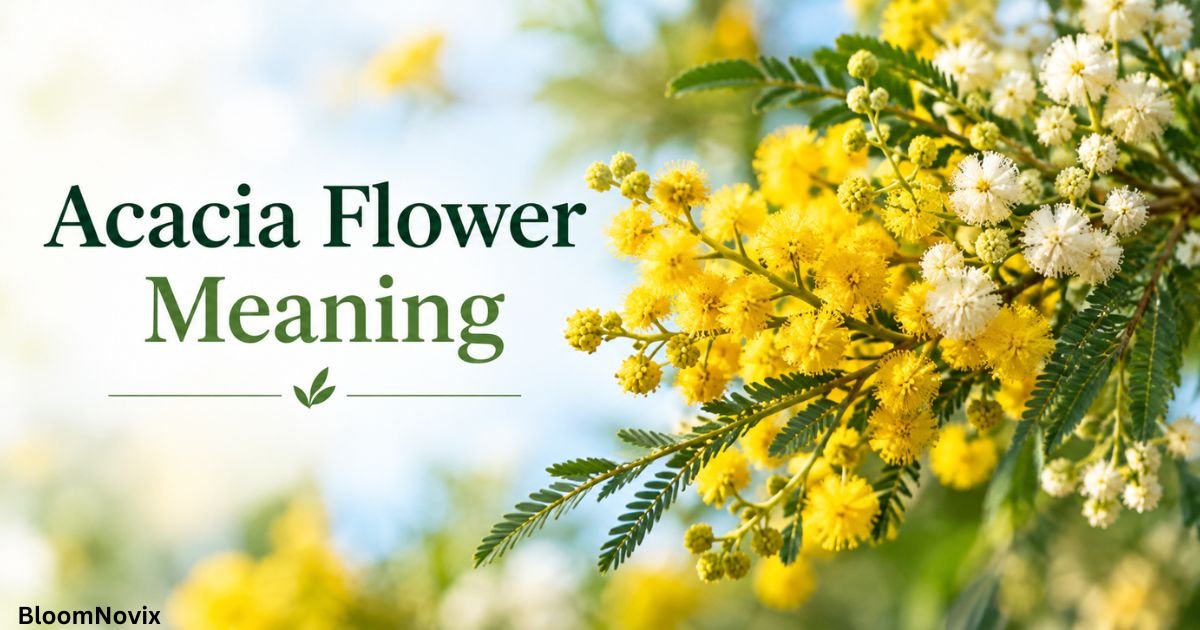
Have you ever looked closely at a tiny yellow acacia flower and wondered what it might mean? The acacia flower meaning is connected with friendship, secret love, remembrance, and immortality. Its small, fluffy blooms may look delicate, but the stories behind them are surprisingly deep.
Acacia can also be a little confusing. The word “mimosa” is sometimes used for certain acacia trees, while “acacia honey” can come from a different plant than the one you picture when you hear the name. Then there are pink flowers sold as “acacia,” which can make things even more confusing.
That is what makes acacia so interesting. Its meaning is not limited to one feeling or one tradition. Depending on the color, culture, and occasion, this little flower can carry a very different message.
Acacia Flower Meaning: Quick Answer
The acacia flower is often linked with friendship, secret love, immortality, elegance, and rebirth. Its symbolism changes across cultures, so the same flower can carry a slightly different message depending on where and how it is used.
- Victorian flower language: secret love and friendship.
- Freemasonry: the immortal soul and life beyond death.
- Italy: respect and appreciation for women, especially around March 8.
- Australia: national pride through the golden wattle.
- Bible: acacia wood was used for sacred objects and parts of the Tabernacle.
The color and occasion matter, too. Yellow acacia can suggest friendship and warmth, while white may be connected with remembrance. Pink or cream shades can feel softer and more romantic. So before giving acacia flowers, think about both the color and the message you want to send.
Acacia Flower Symbolism in Different Cultures and Religions
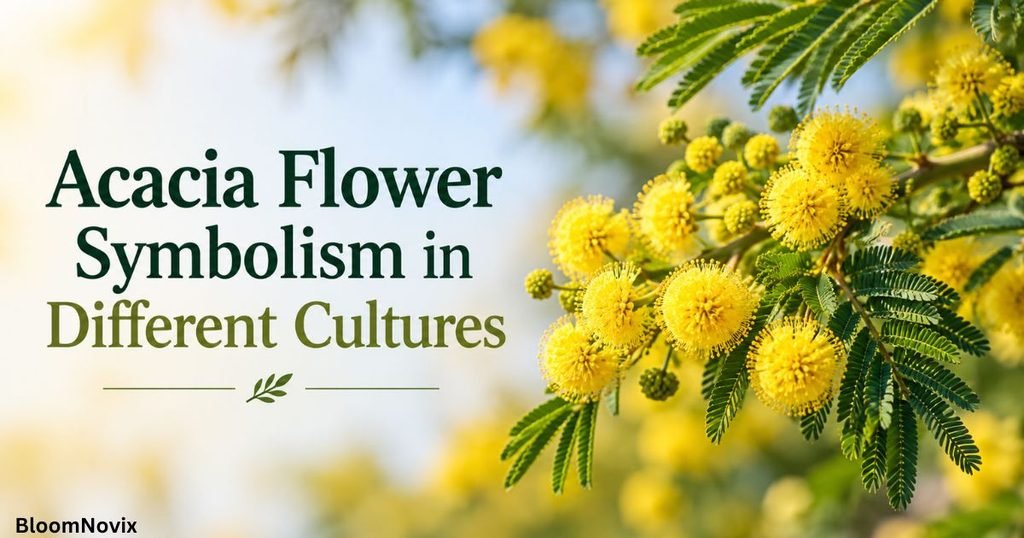
Acacia appears in many faiths and old stories. Ancient Egyptians linked the tree to life and rebirth. Some Egyptian legends tie it to Osiris, the god who returns from death. The tree’s tough wood and bright blooms made it a natural symbol of eternal life.
In the Hebrew Bible, the wood is called shittim. Scholars connect it to acacia trees of the desert. The Book of Exodus says builders used it for the Ark of the Covenant. This gave the tree a deep biblical meaning of holiness and endurance.
Freemasons tell the story of Hiram Abiff, the master builder of the temple. In the tale, friends mark his grave with an acacia sprig. The sprig now stands for the soul that never dies. Many lodges still use it in rituals and funeral rites today.
Acacia Flower Meaning in Love, Friendship and Life
In love, acacia is a quiet flower. It does not shout. It whispers. People give it when they feel something but cannot say it yet. This is why the secret love meaning has lasted for generations.
In friendship, acacia says, “I trust you.” The yellow clusters feel warm and open. They suit birthdays, reunions, and thank-you notes. A small bunch often feels more personal than a large rose bouquet.
In life, acacia stands for resilience. The tree survives drought, fire, and poor soil. Then it blooms bright in the cold months. Many people read this as a sign of hope, new beginnings, and strength after hardship.
Origin of the Name
The word “acacia” comes from the ancient Greek word akakia. It likely connects to ake, which means “point” or “thorn.” Many acacia branches carry sharp spines. The name fits the tree well.
Greek writers used the word long before modern science. The physician Dioscorides described an Egyptian thorny tree with this name. Later, botanists adopted it for the whole group. Carl Linnaeus gave the genus its formal Latin place in the 1700s.
The story does not end there. Experts split the genus in the early 2000s. Today, “Acacia” officially belongs to the Australian species. You will learn more about this change in the botany section.
Read Also: Pasque Flower Symbolism
Acacia in Victorian Flower Language
Victorians loved secret messages. Talking about feelings was often rude, so flowers spoke instead. Small books called floral dictionaries told each bloom’s meaning. Acacia often meant secret love and friendship.
Some books added “elegance” and “chaste love.” Chaste here means pure and modest, not cold. A suitor could send acacia to show respect without bold words. The receiver could answer with another flower.
The meaning also fits the plant’s look. Soft, fragrant blooms hide among sharp thorns. That image matched a love that stays protected. Note that different books listed slightly different meanings, so context always mattered.
Botanical Foundations & Profile
Acacia refers to a large group of trees and shrubs in the pea family. The group includes more than 1,000 species, with many native to Australia, Africa, and warm regions of Asia and the Americas. Depending on the species, acacias can bloom from winter into spring and may produce flowers in shades of yellow, cream, or white.
The name Acacia can be confusing because botanists changed how the group was classified. In 2005, many African and American species were moved into the genera Vachellia and Senegalia. The name Acacia was kept for the Australian group, with the change becoming established in botanical use by 2011.
You may still see the word “acacia” used for several different plants in nurseries, gardens, and flower shops. That is why the scientific name matters when you are identifying a plant or checking its care needs. Hardiness also varies by species, although many commonly grown acacias do well in USDA Zones 9–11.
History & Cultural Timeline
People have used acacia for thousands of years. The wood, gum, and bark all had value. The timeline below shows how the plant moved from daily use to deep symbolism.
- Ancient Egypt: Acacia wood and resin served in building and ritual work.
- Biblical era: Shittim wood formed sacred furniture, including the Ark.
- Greek and Roman times: Writers described acacia gum for medicine and ink.
- 1700s: Linnaeus placed the name in modern botany.
- 1800s: Victorians gave acacia a place in flower language.
- 1946: Italy chose mimosa, mostly acacia blooms, as a Women’s Day symbol.
- 2005 to 2011: Botanists split the genus into new groups.
Each step added a new layer of meaning. Practical use came first. Spiritual meaning grew from that use. Romance and national pride came later.
Symbolism Deep-Dive
Immortality
Acacia wood resists rot and insects. It can stay strong for a very long time. Ancient builders noticed this and valued it. The wood’s lasting power became a sign of immortality and the eternal soul.
Friendship
Many acacias grow in groups. Their branches reach and overlap. They share shade with grasses, birds, and animals. The tree also hosts helpful ants in some regions, which guard it in return for shelter. This shared life makes acacia a sign of trust and steady friendship.
Secret Love
The blooms are soft and sweet. The branches are hard and sharp. That contrast tells a story of tender feelings kept safe. When you give acacia, you say, “I care, and I will protect this feeling.” It suits early romance well.
Meaning by Color
Color changes the message. Real acacia blooms are mostly yellow, with some cream and pale gold forms. White and pink are rare in true acacia. Many pink “acacia” pictures online actually show other plants.
This matters for honest gifting. A florist may sell a mixed bunch and call it acacia. Ask for the species name if the message is important. A correct choice avoids mixed signals.
The table below lists the main color meanings. It also notes where the color is common. Use it as a gentle guide, not a strict rule.
Color Meanings & Cultural Safety Matrix
| Color | Meaning | Culture Note | Gift Safety |
| Yellow | Joy, friendship, new beginnings | Golden wattle is Australia’s emblem | Safe for almost any occasion |
| Cream | Elegance, quiet grace | Common in formal bouquets | Safe for colleagues and elders |
| White | Purity, remembrance | Linked to the soul in Freemasonry | Best for memorials |
| Pink | Gentle affection | Often a different plant, such as Albizia | Check the species first |
When unsure, choose yellow flower color. It is warm, clear, and rarely misread.
Global Traditions & Literary Impact
In Australia, the golden wattle (Acacia pycnantha) is the national floral emblem. It appears on coins, sports uniforms, and the coat of arms. The country marks National Wattle Day every September 1. The date also signals the first day of spring there.
In France, the town of Mandelieu-la-Napoule holds a Mimosa Festival each winter. Streets fill with yellow floats and flower parades. The south of France grows large acacia groves for the cut-flower trade. Poets there often link the bloom to sunshine in cold months.
Writers have long used acacia as a symbol of memory. Scripture mentions it in Exodus. Masonic texts use it for death and rebirth. Modern poems use it for hardy hope. In each case, the tree stands for something that outlasts loss.
Mimosa Day in Italy: Why Acacia Is Gifted on March 8
On March 8, Italy celebrates La Festa della Donna. Men give women small sprigs of yellow blooms. Italians call them mimosa. Most of these flowers are actually Acacia dealbata, also called silver wattle.
The tradition began in 1946. The Union of Italian Women, known as UDI, chose the flower. It was cheap, it bloomed in early March, and it grew wild in the countryside. Women of every income could share it. That fairness made it a perfect symbol.
Today, the gesture means respect, thanks, and solidarity. Friends, coworkers, and families all join in. Many Italians also bake a mimosa cake that copies the flower’s look. If you plan a gift, a small sprig with a kind note works best.
Acacia in Pakistan and South Asia: Kikar, Babul and Phulai
South Asia has its own acacia story. The kikar or babul tree is Vachellia nilotica. It grows across Pakistan, India, and nearby lands. Many people know it from village paths and canal banks.
Another local tree is phulai, known as Senegalia modesta. It grows in the dry hills and foothills of Punjab and Khyber Pakhtunkhwa. Locals use its wood for tools and fuel. Its sweet, small flowers feed bees in spring.
These trees carry a message of toughness. They live in heat and poor soil. Farmers value their shade, pods, and timber. Their tiny blooms may not look fancy, but they share the same spirit of resilience found across the acacia family.
Economic, Culinary, and Medicinal Uses
Acacia has real economic value. Gum arabic is a natural thickener and stabilizer. It comes mainly from Senegalia senegal and Vachellia seyal. Makers use it in soft drinks, sweets, inks, and watercolor paints.
Now a key fact. Most honey sold as acacia honey does not come from true acacia. It usually comes from Robinia pseudoacacia, the black locust, also called “false acacia.” It is light, clear, and mild. The name is common in trade, so read labels with care.
Some cultures have used acacia bark, pods, and leaves in home remedies. Science does not confirm all these claims. Do not eat or drink acacia preparations without expert advice. Always ask a doctor before using any plant for health reasons.
Explore More: Renaissance Flower Symbolism
Ultimate Etiquette & Gifting Guide
A good gift fits the person and the moment. Acacia suits many cases because it is warm and light. Keep the bunch small and fresh. Add a short note to make the message clear.
| Relationship | Best Color | Message |
| Close friend | Yellow | “Our friendship is steady and true.” |
| Early romantic interest | Pink-toned or cream stems | “I feel something I have not said yet.” |
| Memorial or reflection | White or cream | “I honor what lasts beyond this life.” |
| Respected colleague | Cream | “I admire your quiet, steady grace.” |
| Women’s Day gesture | Yellow | “Thank you for all you do.” |
Time your gift well. Fresh blooms last only a few days in a vase. Buy them close to the event. Avoid giving acacia to anyone with heavy pollen allergies.
Universal Safety Rule
Handle acacia with care. Many species have sharp thorns. Wear gloves when you cut or arrange stems. Strip the lower thorns before you wrap a bouquet.
Safety also covers the gift note. If your message is private, write it on a card and seal it. A bunch of acacia can speak softly, but a card can say what the bunch cannot. This avoids awkward moments in public.
Finally, protect the people around you. Keep thorny branches away from children and pets. Tell the receiver to trim stems with sturdy scissors. A safe gift feels more caring than a perfect one.
Acacia vs. Close Lookalikes
Several yellow shrubs look like acacia from far away. Broom (Cytisus) is the most common twin in gardens. Both bloom in spring and show bright yellow color. Yet the details differ.
Acacia flowers form small, fluffy balls. Broom flowers look like tiny open peas. Acacia leaves are often feathery or flat and leaf-like. Broom leaves are small and simple, with few thorns.
Scent helps too. Acacia often smells sweet and strong. Broom smells milder. Look at the flower shape first, then check the leaves, then smell the bloom.
How to tell them apart
Start with the flower shape. Fluffy pom-poms point to acacia. Pea-like petals point to broom. Next, check the stems for thorns, as many (not all) acacias carry them, while broom has few. Last, look at the leaves. Feathery leaves suggest acacia or mimosa.
Acacia vs Mimosa vs Albizia vs Robinia: Which Is Which?
These four names cause the most confusion. Florists say “mimosa” for acacia stems. Botanists use Mimosa for a different genus, such as the sensitive plant, Mimosa pudica. Garden shops also sell “mimosa trees” that are really Albizia.
The table below clears up each name.
| Plant | Flower Look | Real Identity | Common Mix-up |
| Acacia | Yellow fluffy balls | True acacia, mostly Australian | Called “mimosa” by florists |
| Mimosa (botanical) | Pink or purple puffs | Small herbs or shrubs, like touch-me-not | Confused with acacia |
| Albizia (silk tree) | Pink, feathery tufts | Often called “mimosa tree” | Mistaken for pink acacia |
| Robinia (black locust) | White, hanging clusters | “False acacia” | Source of “acacia honey” |
The lesson is simple. Names in shops and in science do not always match. When you need a clear answer, ask for the Latin name.
Practical Maintenance & Domestic Safety
Growing acacia is easy if you give it the right spot. Plant it in full sun. Use well-drained soil, because roots dislike standing water. Water young trees often. Established trees handle dry spells well.
Prune after flowering, not before. Many species bloom on last year’s growth. Wear thick gloves and long sleeves. Cut dead wood first, then shape the tree lightly. In cold regions, grow acacia in a pot and move it indoors in frost.
Pet safety needs species-level care. Some acacias contain natural compounds that can harm animals. Thorns can also injure paws and mouths. Check the exact species on the ASPCA plant list before planting near pets. Call your vet quickly if your pet shows drooling, vomiting, or weakness.
Acacia Flower Tattoo and Dream Meaning
An acacia tattoo often stands for resilience, loyalty, and remembrance. Some people choose it to honor a lost loved one. Others pick it as a sign of growth after pain. Freemasons may wear it as a symbol of the soul.
Placement adds meaning. A small sprig on the wrist or ribs feels private. A branch on the shoulder feels bold and strong. Yellow ink shows joy. Black ink shows depth and calm.
Dream meanings are personal, not scientific. Seeing acacia in a dream may point to hidden love or a lasting friendship. A thorny branch may warn of a guarded heart. Treat these ideas as gentle reflection, not firm prediction.
Expert Curations & Misconceptions
Here are fast facts worth sharing:
- Some acacia species grow over 70 feet tall.
- Certain African acacias host ants that defend the tree.
- Silver wattle (Acacia dealbata) supplies much of the world’s “mimosa” cut flowers.
- Golden wattle became Australia’s official floral emblem in 1988.
- Wattle blooms in August and September in Australia, but in January to March in Europe and the US.
Now the myths. Myth: All acacias have thorns. Reality: Many Australian species have none. Myth: Acacia grows only in Australia. Reality: It also grows across Africa, Asia, and the Americas, though experts now use new names for many of them.
Myth: Acacia honey comes from acacia flowers. Reality: It usually comes from black locust. Two quick tips for florists: cut stems when only some buds are open, and keep them in cool water. Strip lower leaves so the vase stays clean.
Questions About Acacia Flower Meaning
Is acacia the same as mimosa?
Not exactly. Florists call acacia “mimosa,” but botanists use Mimosa for a different plant group.
Why do men give mimosa flowers on International Women’s Day?
It is an Italian tradition from 1946. The flower was cheap, seasonal, and open to all women.
What does acacia mean in the Bible?
It means holiness and endurance. Shittim wood, linked to acacia, built the Ark of the Covenant.
What does the acacia flower mean in Freemasonry?
It stands for the immortal soul. The legend of Hiram Abiff uses an acacia sprig to mark his grave.
Is acacia honey really made from acacia flowers?
Usually no. Most of it comes from black locust (Robinia), also called false acacia.
Is golden wattle the same as acacia?
Yes. Golden wattle (Acacia pycnantha) is a true acacia and Australia’s national flower.
What does an acacia flower tattoo symbolize?
It symbolizes resilience, loyalty, and remembrance. Many people also link it to the soul.
What does it mean to dream about acacia flowers?
It often suggests hidden love or lasting friendship. This is a personal reading, not a fact.
Is kikar (babul) an acacia tree?
Yes, in common speech. Botanists now call it Vachellia nilotica.
Which acacia species are poisonous to dogs and cats?
Some contain harmful natural compounds. Check the exact species on the ASPCA list and ask your vet.
Final Words
The acacia flower meaning brings together friendship, quiet love, remembrance, and the hope of new beginnings. Its soft blooms may look delicate, but the symbolism behind them has lasted for centuries. Even its thorns add another layer to the story, reminding us that love and tenderness often need care.
The meaning can change with the flower’s color, the occasion, and the tradition behind it. Yellow can feel warm and friendly, while white may carry a message of remembrance. Once you understand these small differences, acacia becomes more than just a pretty cluster of flowers. It becomes a thoughtful way to express something you may not always know how to say.
BloomNovix is managed by an experienced team of content writers and SEO specialists with 4+ years of expertise in gardening and plant care. We provide well-researched guides, gardening tips, and insights on floral meanings to help plant lovers grow their indoor and outdoor gardens with confidence.