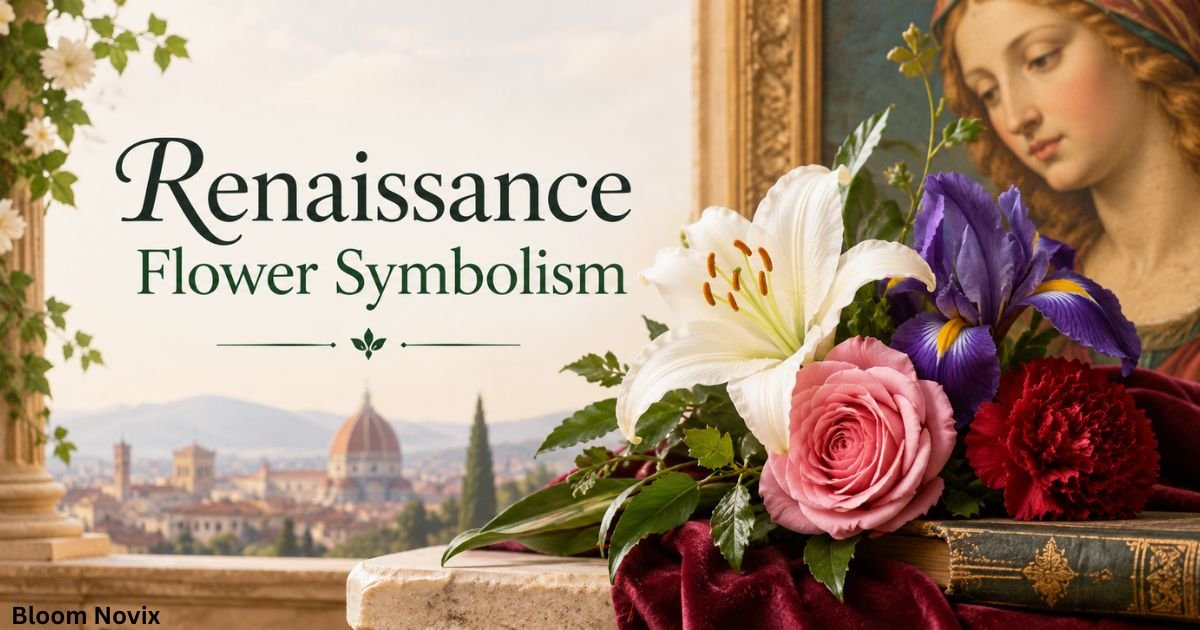
Look at the small vase of flowers tucked into a Renaissance painting. It may seem like a simple decorative detail, but the artist may have chosen each flower for a reason. Renaissance flower symbolism gave roses, lilies, violets, carnations, and other plants meanings connected with faith, love, purity, marriage, and sorrow.
The meanings were not always fixed. A flower’s color, position, religious subject, and the objects around it could change what it suggested. This guide looks beyond the most familiar examples to explore lesser-known flowers, classical influences, color meanings, and the ways artists used plants to add another layer to their paintings. By the end, those quiet floral details may look very different to you.
What Is Renaissance Flower Symbolism?
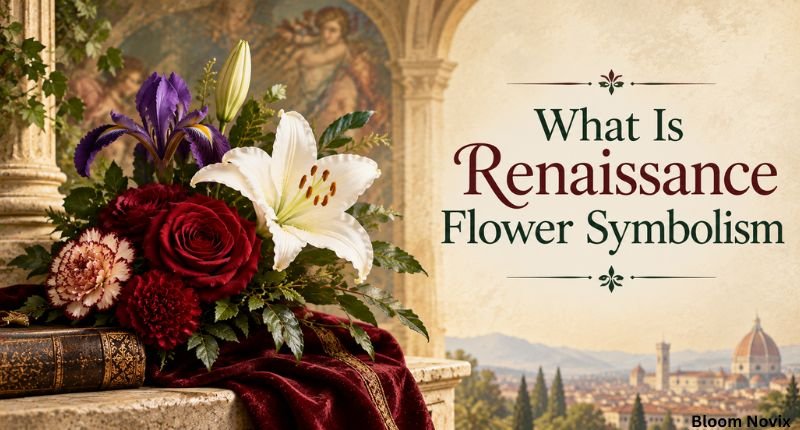
Renaissance flower symbolism is the use of flowers in art to suggest religious, moral, emotional, or cultural ideas. Artists used lilies to represent purity, roses for love, charity, or sacrifice, and violets for humility. Carnations could suggest love, courtship, or marriage. The meaning was often shaped by the flower’s color, position, and the subject of the painting.
This was not a strict system with one meaning for every flower. There was no single dictionary that artists followed. Instead, these associations grew from Christian flower symbolism, classical mythology, medieval herbals, literature, gardening, and everyday experience with plants. A single flower could therefore suggest more than one idea in the same artwork.
Context is especially important. A lily placed beside the Virgin Mary or an angel carries a different significance from a lily simply growing in a garden. Looking at the people, objects, colors, and setting around a flower can help explain why the artist included it.
Key Takeaways
- Lilies were strongly associated with purity and chastity, especially in images of the Virgin Mary.
- Roses could suggest love, charity, martyrdom, or the Virgin Mary.
- Carnations connected sacred love with courtship and marriage in different types of Renaissance imagery.
- Irises could be associated with suffering, the Passion, resurrection, or seasonal renewal.
- Violets were commonly linked with humility.
- Color, setting, and surrounding objects could influence a flower’s meaning.
- Renaissance paintings by artists such as Botticelli and Leonardo show how plants could add symbolic meaning to a scene.
Why Flowers Mattered in Renaissance Culture
The Renaissance ran from the fourteenth to the sixteenth century in Europe. Artists wanted to paint the real world with care. Plants made a perfect subject. They were beautiful, familiar, and full of meaning.
People lived close to plants. They grew flowers for food, medicine, perfume, and dye. Monks tended herb gardens. Physicians read herbals to treat illness. So a rose in a painting felt personal, not abstract.
Churches also taught that nature carried messages from God. Viewers expected to find lessons in the natural world. A painter could therefore pack a sermon into one bloom. That made flowers ideal visual symbols.
- Flowers were easy to recognize.
- They carried rich religious stories.
- They fit small spaces, from borders to bouquets.
- They allowed more than one reading.
The Christian Roots of Renaissance Flower Symbolism
Christianity gave this visual language its strongest frame. The Bible mentions roses, lilies, and fields of flowers. Church writers later tied plants to saints, virtues, and holy events. Artists carried those links into altarpieces, prayer books, and panel paintings.
The Virgin Mary sat at the center. Writers called her the “rose without thorns” and the lily among thorns. Painters showed her with white lilies, red and white roses, and shy violets. Each flower praised a different side of her character.
The hortus conclusus, or enclosed garden, added another layer. It comes from the Song of Songs and stood for Mary’s purity. Painters placed her inside a walled garden full of blooms. The walls kept the world out and kept her virtue safe.
- Passion and sacrifice: red roses, carnations, irises
- Purity: white lilies, white roses, strawberries
- Humility: violets, daisies
- Resurrection: spring flowers such as irises
How Classical Mythology Shaped Flower Meanings
The Renaissance also revived Greek and Roman stories. Ancient poets had explained flowers as transformed people. Artists loved these tales. They gave painters a rich set of ideas beyond church teaching.
Narcissus fell for his own reflection and became a flower. That story made the narcissus a sign of vanity. Hyacinthus, a young man killed by Apollo’s discus, gave his name to the hyacinth. The anemone grew from the blood of Adonis, the lover of Venus.
Flora, the Roman goddess of flowers, ruled spring. Botticelli painted her scattering blossoms in Primavera. Venus also owned the rose and the myrtle. Christian and pagan meanings could share one canvas without conflict.
7 Essential Flowers in Renaissance Flower Symbolism
These seven flowers appear again and again. Learn them first, and you will decode most paintings. Each one carries more than one meaning. We start with the rose and work down the list.
Each flower earned its meaning for a reason. Some meanings came from color. Others came from shape, scent, or growth habit. That logic makes the meanings easier to remember.
Meanings shifted by region and artist. Treat every entry as a likely reading, not a rule. Now meet the seven.
1. The Rose: Love, Charity, and Martyrdom
Red roses stood for blood, martyrdom, and Christ’s Passion. They also meant charity and divine love. White roses meant purity and chastity. The thorns reminded viewers of suffering.
The rose also belonged to Venus, the goddess of love. So it could signal earthly romance too. People used roses for rosewater, food, and medicine. That daily use made the symbol feel close to home.
2. The White Lily: Purity and the Virgin Mary
The white lily means purity and chastity. It belongs to the Virgin Mary above all. In Annunciation scenes, the angel Gabriel often holds one. Sometimes a vase of lilies stands beside Mary instead.
Saints known for chastity, such as St. Joseph, also carry lilies. The flower spoke without any caption. A viewer saw the lily and understood the message at once.
3. The Carnation: Sacred Love and Marriage
Carnations and other pinks bridged the sacred and the secular. In a Madonna and Child, a carnation could point to divine love. In a portrait, the same flower could hint at betrothal. Its clove-like scent added a sense of affection.
Some viewers also linked the carnation to the nails of the Cross. So the flower could carry both joy and sorrow. Leonardo’s Madonna of the Carnation shows this double meaning well.
4. The Iris: Suffering and Renewal
The iris has sword-shaped leaves. Viewers linked them to the sword of sorrow that pierces Mary’s heart. The flower therefore became a sign of the Passion. It also blooms in spring, so it suggested renewal.
Florence added a twist. The city’s emblem, the giglio, looks like a lily, but many scholars think it is an iris. The debate continues. Either way, the flower carried civic pride as well as faith.
5. The Violet: Humility
The violet grows low to the ground. Its blooms hide among the leaves. Christian writers saw modesty in that habit. They used the violet as a sign of humility.
Violets often appear around the Virgin and saints. Their deep purple also hinted at penance and sorrow. That shows how observation shaped meaning. The plant’s own habits taught the lesson.
6. The Columbine: The Holy Spirit and Mary’s Sorrows
The columbine’s petals look like a ring of doves. Its name even comes from the Latin word for dove. That shape linked it to the Holy Spirit. Painters used it in scenes that stressed divine presence.
Its drooping head also suggested grief. Some writers tied the flower to the sorrows of Mary. Dark purple columbines carried this note most strongly. Herbals also listed the plant for medicine.
7. The Strawberry: Purity and Virtue
The strawberry appears in manuscript borders and religious scenes. It could stand for purity and righteousness. Its three-part leaves hinted at the Trinity. Its red fruit also suggested the Passion.
Some writers noticed that they plant flowers and fruits together. They read this as fruitfulness without loss of purity. That idea suited Marian images. Not every viewer agreed, so context still matters.
More Renaissance Flowers: Poppy, Marigold, Sunflower, Daisy, and Pansy Meanings
The seven flowers above were not the only plants that carried symbolic meaning in Renaissance art. Artists used many other flowers and plants, although their meanings could change with the subject, color, and setting.
The poppy was associated with sleep, death, and remembrance. These ideas came from older classical and Christian traditions rather than from one fixed Renaissance code. Its red color could also connect the flower with blood and Christ’s Passion in some Christian imagery.
The marigold had strong associations with the Virgin Mary in some European traditions. Its golden color and its name, linked to “Mary’s gold,” helped support this connection. It could suggest devotion and remembrance, although its exact meaning depended on the artwork and period.
The daisy was associated with innocence, purity, and humility. In Christian art, daisies sometimes appeared in scenes involving the Christ Child, where their simple appearance supported ideas of childhood innocence and virtue.
The pansy has an interesting linguistic connection to thought. Its name comes from the French pensée, meaning “thought.” This helped give the flower associations with remembrance and loving thoughts. Some later Christian interpretations also connected its three-part form with the Trinity, although this should not be treated as a universal Renaissance meaning.
The sunflower requires a little more caution. Sunflowers came to Europe from the Americas in the sixteenth century, so they were not part of the earlier Renaissance flower tradition. As the plant became known and cultivated in Europe, artists and writers gradually gave it symbolic associations, including devotion and turning toward the sun. Its symbolism therefore belongs more accurately to the later Renaissance and post-Renaissance period rather than to early Renaissance art.
- Poppy: sleep, death, remembrance, and sometimes Christ’s Passion
- Marigold: devotion, Mary, and remembrance
- Daisy: innocence, purity, and humility
- Pansy: thought, remembrance, and loving affection
- Sunflower: devotion and later associations with the sun
Renaissance Flower Symbolism Chart
Use this chart as a quick field guide. It covers the main flowers in this article. Each row shows the usual meaning and where to look. Keep the table handy on your next museum trip.
Remember that painters had freedom. A flower in your painting may break the pattern. That is normal. The chart gives you a starting point, not a final answer.
Look at the “Look for” column first. It gives a simple visual clue for each flower. Spot the clue, then check the setting. That two-step habit speeds up your reading.
| Flower | Main Renaissance Meaning | Common Setting | Look For |
| Red rose | Passion, martyrdom, divine love | Altarpieces, devotional art | Thorns, Christ or saints |
| White rose | Purity, chastity | Marian images | Mary in a rose garden |
| White lily | Purity, chastity | Annunciation scenes | Angel Gabriel, a vase |
| Carnation | Sacred love, betrothal | Portraits, Madonnas | Flower held in the hand |
| Iris | Sorrow, Passion, renewal | Altarpieces | Sword-shaped leaves |
| Violet | Humility | Religious scenes | Small purple blooms low down |
| Columbine | Holy Spirit, Mary’s sorrows | Manuscripts, paintings | Dove-shaped petals |
| Strawberry | Purity, virtue | Manuscript borders | Three-part leaves |
| Poppy | Sleep, death | Memento mori scenes | Red or pale petals, seed heads |
| Marigold | Devotion to Mary | Marian art | Orange-gold blooms |
| Daisy | Innocence | Christ Child images | Small white petals |
| Pansy | Thought, remembrance | Portraits, manuscripts | Three-color faces |
Renaissance Flower Symbolism by Color: Red, White, Yellow, Blue, and Purple
Color often shaped meaning more than the flower itself. Pigments were costly and loaded with ideas. Blue came from ground lapis lazuli, so painters saved it for the Virgin’s robe. A blue flower beside her therefore felt heavenly. Color was never random.
Red and white roses also carried politics in England. The red rose stood for the House of Lancaster. The white rose stood for York. The Tudor rose later joined the two after the Wars of the Roses. A viewer in England could read a rose both ways.
Do not treat color as a fixed law. Painters also chose colors for realism or beauty. A yellow flower may simply be yellow. Look for repeated patterns across the whole painting before you decide.
| Color | Common Meaning | Flower Examples |
| Red | Passion, martyrdom, love | Red rose, carnation, poppy |
| White | Purity, chastity | Lily, white rose, daisy |
| Blue | Heaven, the Virgin Mary | Iris, columbine |
| Purple | Humility, penance, sorrow | Violet, pansy, dark columbine |
| Yellow | Divine light, glory; sometimes envy | Marigold |
| Pink | Earthly love, betrothal | Pinks, carnations |
Famous Renaissance Paintings and the Flowers Hidden in Them
Real paintings prove the theory. They show how artists used flowers on purpose. Many are easy to find in major museums. Knowing them also lifts your trust in these meanings.
Botticelli’s Primavera (around 1480) is a flower feast. Scholars have identified well over a hundred plant species in it. Flora scatters and blooms while spring arrives. Hugo van der Goes’s Portinari Altarpiece (1470s) places a vase of irises, columbines, and lilies in the foreground. Each bloom points to Mary’s role and sorrow.
Leonardo’s Madonna of the Carnation (about 1478–80) puts a carnation in the Virgin’s hand. It points to love and the Passion at once. Stefan Lochner’s Madonna of the Rose Bower (around 1450) wraps Mary in roses and an enclosed garden. A portrait attributed to Jan van Eyck, known as the Man with Pinks, shows a carnation as a courtship clue.
- Primavera, Botticelli: spring, Flora, abundance
- Portinari Altarpiece, van der Goes: irises, columbines, lilies
- Madonna of the Carnation, Leonardo: love and Passion
- Madonna of the Rose Bower, Lochner: roses, the enclosed garden
- Man with Pinks, attributed to van Eyck: betrothal
Italian vs. Flemish Renaissance Flower Symbolism
Italy and Flanders shared a faith but painted flowers differently. Italian artists loved classical ideas. They drew on myths, ideal gardens, and graceful design. In many Italian works, flowers add rhythm and grace as well as meaning. Botticelli shows this style well.
Flemish painters worked in oil paint. Oil let them render fine petals, dew, and shadow. They loved close observation and quiet interiors. Flowers often sit in a vase on a table or window ledge. Van der Goes shows this style well.
These are broad trends, not strict rules. The two traditions also traded ideas. The Portinari Altarpiece came from Flanders to Florence and influenced local painters. When you read a painting, ask where the painter trained.
- Italian: myth, ideal gardens, grace, classical ideas
- Flemish: fine detail, vases, real plants, domestic scenes
Flowers, Death, and the Memento Mori Tradition
Flowers bloom, then fade. Renaissance viewers saw that cycle as a lesson. It reminded them that life is short. Artists called this idea memento mori, meaning “remember you must die.”
Poppies carried the link to sleep and death. Wilting petals, fallen blooms, and small insects strengthened the warning. Late Renaissance and early Baroque flower pieces, such as those by Ambrosius Bosschaert and Jan Brueghel the Elder, use this language well. Beauty and decay share the same vase.
The message was not always gloomy. Spring flowers also promised resurrection. The same iris that suggested sorrow also suggested new life. Read death symbols as a call to live well, not only as a threat.
- Signs to spot: dropped petals, wilting stems, insects, skulls, hourglasses
- Hope signs: spring bloomers, buds, evergreen leaves
Gardens and the Renaissance Ideal of Nature
Real gardens mattered as much as painted ones. Italian villas used symmetry, geometry, and fountains. Statues from classical myths stood among the hedges. A garden showed order, wealth, and learning all at once.
Science also entered the garden. Padua’s university botanical garden opened in 1545. Pisa opened a year earlier. Scholars studied plants for medicine there. That fusion of study and beauty shaped how artists saw flowers.
Northern Europe loved gardens too. English knot gardens wove herbs and flowers into neat patterns. Painters borrowed these scenes for backdrops. A garden in a painting could signal paradise, status, or both.
How to Read Flowers in a Renaissance Painting
Slow down before you decide what a flower means. Stand back first, then step closer. Notice how the painter arranged the scene. A few quick steps will sharpen your eye.
Pay special attention to gesture. A flower in a hand or in an angel’s grasp is almost always deliberate. A flower in the far background may just set the scene. Painters also added plants to show botanical skill or to mark the season.
Beware of internet lists that claim one fixed meaning. They flatten a rich tradition. Compare what you see with museum notes and art-history sources. That habit keeps your reading honest.
- Identify the subject. Is it a religious scene, a portrait, or a myth?
- Note the color. Red and white often point to different ideas.
- Check placement. Held flowers matter more than background ones.
- Scan nearby objects. Clothing, books, and architecture add clues.
- Count and group. A vase of three or four types often tells a story.
- Read the label. Museum notes often name the flowers for you.
Renaissance Flower Symbolism vs. the Victorian “Language of Flowers”
The Victorians loved secret messages. In the nineteenth century, floriography became a parlor game. Books listed one meaning for each flower. Lovers sent bouquets to say what they could not speak aloud.
Renaissance symbolism worked differently. No book set the rules. Religion, myth, and local custom shaped each reading. A flower could even carry opposite meanings in two paintings.
This matters because many modern lists mix the two. The idea that a yellow rose means jealousy, for example, is a Victorian-style claim. Do not push it back onto a fifteenth-century painting. Keep the periods apart.
| Feature | Renaissance | Victorian |
| Period | 14th–16th centuries | 19th century |
| Main sources | Christianity, myth, herbals | Printed flower dictionaries |
| Purpose | Religious and moral messages | Personal and romantic messages |
| System | Flexible, context-driven | Standardized, list-driven |
| Audience | Viewers of art | Gift givers and lovers |
| One flower, one meaning? | No | Usually yes |
Renaissance Flower Symbolism in America Today
Few Americans use this symbolism as a formal system. It survives through other doors. People meet it in museums, church art, historical novels, and Renaissance fairs. Major museums such as the Metropolitan Museum of Art and the National Gallery of Art display many of these flowers.
Designers also borrow the style. Moody “Old Masters” bouquets have become popular in weddings and photography. Brides pick lilies for purity or roses for love. Most simplify the old meanings and blend traditions.
Meanings have also turned personal. A lily may mean faith, family, or memory to one person. A rose may honor a grandmother instead of romance. Today your own story often counts more than the old code.
- Wedding flowers and stationery
- Jewelry and home décor
- Fashion prints and book covers
- Fine-art photography and digital art
- Social media posts about symbolism
Renaissance Flower Tattoos: Meanings and Design Ideas
Flower tattoos pair well with Renaissance symbolism. The old meanings give a small design a deep story. The detail of botanical art also suits fine-line ink. Many people choose these flowers for faith, love, or memory.
Pick the flower that matches your story. Then choose a style. Engraving and woodcut looks echo old prints. A vase composition recalls a still life. A small border of leaves can suggest a hortus conclusus.
Share your idea with your artist before you commit. Explain the meaning you want. Ask for color advice too, since red and white change the message. Remember that modern meanings may differ from historic ones, and both are valid.
- Lily: purity, faith, remembrance
- Rose: love, sacrifice, devotion
- Carnation: love, marriage
- Iris: hope, renewal
- Violet: humility
- Columbine: spirit and sorrow
FAQs
What is Renaissance flower symbolism?
It is the use of flowers in Renaissance art to carry religious and moral ideas. Artists drew on Christianity, myth, and nature to say what words could not.
What did flowers symbolize during the Renaissance?
Flowers stood for purity, love, marriage, sacrifice, humility, and renewal. The exact meaning depended on the flower, its color, and the painting.
What flower symbolized purity in Renaissance art?
The white lily symbolized purity. Painters placed it beside the Virgin Mary, especially in Annunciation scenes.
What did the rose symbolize in Renaissance paintings?
Roses stood for love, charity, martyrdom, and Mary. Red roses pointed to Christ’s blood, while white roses meant purity.
What flower represented marriage in the Renaissance?
The carnation, along with other pinks, represented courtship and marriage. Portraits often show sitters holding one as a clue to betrothal.
What did different flower colors mean in Renaissance art?
Red meant passion and sacrifice, white meant purity, and blue pointed to heaven. Purple suggested humility or sorrow, but context could change each meaning.
Which Renaissance paintings are famous for their flower symbolism?
Botticelli’s Primavera and van der Goes’s Portinari Altarpiece are top examples. Leonardo’s Madonna of the Carnation and Lochner’s Madonna of the Rose Bower also stand out.
Did Renaissance people have a “language of flowers”?
Not in the strict Victorian sense. Renaissance symbols were shared habits, so no single guidebook set the meanings.
Can a flower have more than one Renaissance meaning?
Yes, a flower could carry several meanings, even opposite ones. A rose, for example, could mean love, sacrifice, or Mary, depending on the scene.
What flowers symbolized death and the fleeting nature of life in Renaissance art?
Poppies, wilting blooms, and fallen petals pointed to death and time. Painters used them in memento mori scenes to remind viewers that life is short.
Are Renaissance flower meanings still used in America?
Some survive, mainly roses for love and lilies for purity or faith. Most people now choose personal meanings instead of historic ones.
Can I use Renaissance flower symbolism in a tattoo or wedding design?
Yes, many people use these flowers in tattoos and wedding designs. Pick flowers whose meanings fit your story, and tell your artist or florist the message you want.
Conclusion
Renaissance flower symbolism was never a simple code with one fixed meaning for every flower. It grew from Christianity, classical mythology, botanical knowledge, gardening, and everyday life. Roses, lilies, carnations, irises, violets, and other plants could carry different meanings depending on their color, setting, and place within a painting.
That is what makes these floral details so interesting. A small flower in the background might point to purity, love, humility, marriage, sacrifice, or renewal, while another may simply show the artist’s interest in nature. When you look at Renaissance paintings again, pay attention to the flowers alongside the figures, gestures, colors, and other objects. Those small details can reveal another layer of meaning that is easy to miss at first glance.

BloomNovix is managed by an experienced team of content writers and SEO specialists with 4+ years of expertise in gardening and plant care. We provide well-researched guides, gardening tips, and insights on floral meanings to help plant lovers grow their indoor and outdoor gardens with confidence.